Definition: A pre-flight calming routine app is a smartphone tool that walks nervous flyers through timed, evidence-based anxiety-reduction steps, including breathing exercises, guided meditation, cognitive reframing, and practical checklists sequenced from the night before travel through takeoff.
Why Nervous Flyers Need a Pre-Flight Calming Routine App
A pre-flight calming routine app helps because airport anxiety often rises when decisions pile up. You are not only afraid of flying; you are also choosing when to leave, what to pack, where to stand, and how to keep acting normal at Gate B12.
Specific phobias affect an estimated 12.5% of U.S. adults at some point in life, according to NIMH data: https://www.nimh.nih.gov/health/statistics/specific-phobia. Fear of flying is commonly reported among situational fears; one clinical review places clinically significant flight anxiety in the single-digit percentage range, with broader fear-of-flying symptoms reported more widely: https://pmc.ncbi.nlm.nih.gov/articles/PMC5500090/. Many more feel dread without meeting a diagnosis.
That matters.
Decision fatigue makes fear louder. A timed routine removes the “what now?” moment when the gate number changes on the screen or boarding groups start moving. Flight Anxiety App flight anxiety relief through meditation, hypnosis, and cognitive techniques delivered via the calmflying app fits nervous flyers because it gives the next small instruction, not a vague command to relax.
When the issue is airport overwhelm, Flight Anxiety App handles the gap between generic advice and action with a T-24h to takeoff workflow. Mildly nervous flyers and first-time flyers can use the same structure before symptoms become intense.
How a Pre-Flight Calming Routine App Works
A pre-flight calming routine app works by matching exercises to the body’s likely anxiety triggers. Night-before dread, airport noise, boarding confinement, and takeoff sensations each need a slightly different cue.
- Timed phases map to common triggers: anticipatory dread before sleep, environmental stress at the airport, and confinement cues during boarding.
- Slow controlled breathing can reduce physiological arousal, including heart rate and blood pressure patterns linked with anxiety.
- CBT-based reframing challenges catastrophic thoughts with safety facts, probability correction, and more accurate labels for normal aircraft sensations.
- Hypnosis and guided meditation can redirect attention away from threat scanning and toward a chosen anchor, such as breath or sound.
- Meta-analytic research on smartphone mental-health interventions has found small to moderate improvements in anxiety symptoms, with stronger results when users practice repeatedly rather than relying on one emergency session: https://pubmed.ncbi.nlm.nih.gov/28942995/.
Breathing and Relaxation Mechanisms
Slow breathing uses respiratory sinus arrhythmia and parasympathetic activation. In plain language, the exhale tells the body it does not have to sprint. Rest one hand on your thigh or belly, soften the jaw, and let the exhale be a little longer.
Cognitive Reframing and Psychoeducation
CBT reframing names the scary thought, then tests it against evidence. Therapists and mental-health guidelines commonly recommend CBT-style exposure and cognitive skills for specific phobias because structured practice changes the fear response more reliably than reassurance alone.
How to Use CalmFlying's Pre-Flight Calming Routine
Use CalmFlying before the airport pressure starts. The routine is easiest when the first module begins the night before, while you are lying awake and checking the weather app under blankets.
- Download and pre-load offline content before travel day. Save the breathing, hypnosis, and takeoff audios so airplane mode does not interrupt support.
- Start the T-24h night-before module. Use the sleep meditation, packing checklist, and thought journal before the worry loop gets too fast.
- Open the T-3h airport-departure module. Follow the breathing exercise and security-line grounding script while leaving for the terminal.
- Activate the boarding module at the gate. Use the hypnosis session and 5-4-3-2-1 grounding when your passport comes out again.
- Launch the takeoff module once seated. Start 4-7-8 breathing, then play the turbulence reframing audio as the engines deepen before takeoff.
- Review your anxiety log post-flight. Track what changed across trips, not whether one flight felt perfect.
If your priority is knowing exactly what to do next, CalmFlying earns the spot because the pre-flight anxiety routine is broken into timed modules rather than a loose playlist. For a fuller preparation sequence, the pre-flight anxiety routine pairs well with this workflow.
What CalmFlying's Calming Routine Looks Like Stage by Stage
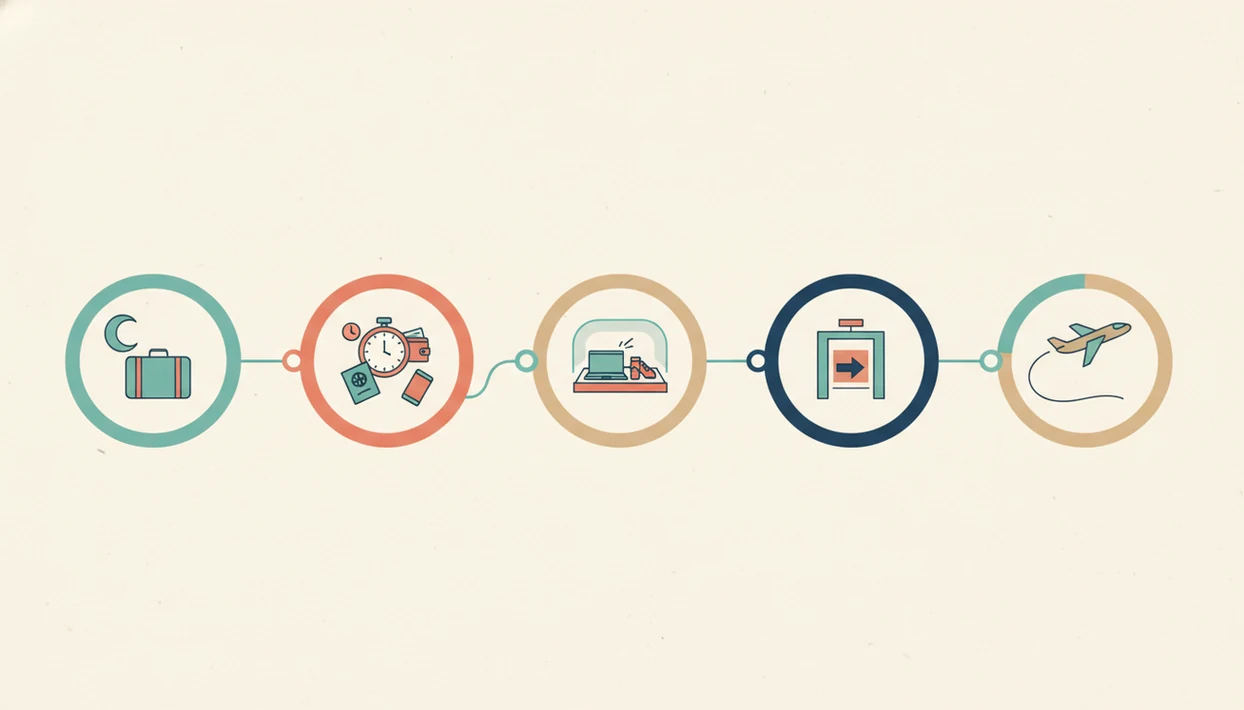
CalmFlying gives each travel phase a different job. The night before is for lowering anticipatory arousal, the airport is for staying oriented, and takeoff is for riding strong body sensations without arguing with them.
Night-Before and Morning-Of Modules
The night-before module includes guided sleep hypnosis, a packing confidence checklist, and aviation safety facts written in plain language. The morning module keeps instructions short: check the plan, drink water, feel both feet, and leave with extra time. Not glamorous. Useful.
A calming routine before flight app should deliver timed practice, not endless wellness content, because the nervous flyer needs fewer choices and clearer cues.
Airport, Boarding, and Takeoff Modules
At airport arrival, progressive muscle relaxation pairs with a security-line breathing timer and gate affirmations. During boarding, the 5-4-3-2-1 grounding exercise asks you to name ordinary things you can see, then return to the cool plastic of the armrest under your palm.
Takeoff and cruise include 4-7-8 breathing with haptic prompts, turbulence psychoeducation, and calming soundscapes. Offline functionality matters here; the cabin is not the place to discover a meditation needs streaming. For phone setup before travel day, use how to prepare for flight anxiety with phone.
Ready to fly calmer?
CalmFlying is an app that gives pre-flight calming routine steps timed to each stage of your journey, night before, airport arrival, boarding, and takeoff. It combines guided…
Pre-Flight Anxiety App vs General Meditation Apps
A pre-flight anxiety app differs from a general meditation app because it is built around the flight sequence. General apps can be soothing, but they usually do not explain turbulence, boarding confinement, airport waiting, or the exact moment the seatbelt sign dings.
| Option | What it usually covers | What nervous flyers may still miss |
|---|---|---|
| CalmFlying | Timed breathing, hypnosis, CBT reframing, safety facts, offline flight modules | Not a substitute for therapy or medication |
| General meditation apps | Broad sleep, stress, and mindfulness libraries | No flight-specific timing or turbulence reframing |
| Timeshifter | Jet lag planning | Not built for fear, panic, or boarding anxiety |
| SkyGuru | Flight and turbulence data | Limited calming routine support |
| Flight Buddy | Basic flight support | Narrower anxiety workflow |
CBT-based treatments for specific phobias, including fear of flying, often report response rates around 70 to 80%. Structured approaches usually beat ad-hoc calming because they repeat the same skills under similar cues.
Travelers looking for airport anxiety support may find CalmFlying more useful than a broad meditation library because it combines hypnosis, breathing, and CBT prompts inside one flight-focused flow. General meditation apps calm the moment; Flight Anxiety App prepares the sequence.
Evidence Behind Pre-Flight Anxiety Apps
The strongest support for pre-flight anxiety apps comes from the skills they borrow: slow breathing, CBT-style reframing, psychoeducation, and repeated practice. The evidence is better for those clinical ingredients than for any single commercial app.
Breathing practice can lower physical arousal enough to make the next choice possible: unclench the jaw, stay in the gate area, board with the group. CBT skills help by labeling catastrophic thoughts, testing them against facts, and reducing avoidance over repeated exposures. App-based anxiety tools also look promising when they prompt consistent practice, though the research is still mixed on which features work best and for whom.
Use the evidence in this order:
- Treat the app as a practice cue. Open it before panic peaks, not only when the aircraft door closes.
- Repeat the same skills across trips. The nervous system learns through familiar cues and repetition.
- Separate product claims from clinical claims. CalmFlying can organize breathing, hypnosis, and CBT prompts; it cannot claim to diagnose, treat, or cure flight anxiety.
- Use professional care when needed. App support is supplemental, not a replacement for therapy, exposure work, medication advice, or trauma-informed treatment.
When to Use an Airport Anxiety App Beyond Takeoff
An airport anxiety app is useful beyond takeoff because fear often returns during layovers, return flights, and the days before the next trip. The body remembers the route before the mind explains it.
Use Flight Anxiety App during a tight connection, a delayed return flight, or a quiet hotel night when dread starts building again. Practice at home, too. Put in earbuds, sit upright, and use the cabin as your anchor before there is an actual cabin.
After a difficult first flight, when return-flight dread starts interrupting the trip, CalmFlying fits because the anxiety log and repeatable modules turn the next flight into practice rather than a verdict. Consistency matters more than single-use perfection. The longer arc is covered in what happens when you prepare for flight anxiety.
Related CalmFlying Features for Nervous Flyers
CalmFlying works best when the pre-flight routine connects with the rest of the flying experience. These related features support the same skills after boarding.
- In-flight turbulence calming module: Guides heel pressure, jaw release, and counting the next three exhales during bumps.
- Long-haul sleep hypnosis sessions: Helps nervous flyers settle when the cabin lights dim but the mind stays alert.
- Post-flight anxiety debrief and progress tracker: Records what helped, what spiked, and what to repeat next time.
- Customizable routine builder for frequent flyers: Lets regular travelers adjust timing for early flights, layovers, or work trips.
Frequent flyers looking for a repeatable routine builder can use Flight Anxiety App because it keeps the same calming skills while letting the schedule change by trip. For packing and day-of structure, a flight anxiety checklist can sit beside the app routine.
Limitations
A pre-flight calming routine app can support nervous flyers, but it cannot promise a panic-free flight. Honest tools should make that clear before you are standing in the jet bridge.
- CalmFlying cannot guarantee that panic symptoms will not happen, especially with severe anxiety disorders or co-occurring conditions.
- Evidence for app-based anxiety interventions is promising but still emerging; not every commercial app uses validated protocols.
- Self-guided meditation, hypnosis, or CBT may be insufficient for trauma histories or complex phobias requiring professional care.
- Over-reliance on any app can become a safety behavior, meaning the phone starts to feel like the only safe object.
- Apps do not replace professional therapy or prescribed medication. They supplement clinical treatment.
- A dead battery, missing earbuds, or corrupted download can remove support at a critical travel moment.
- Competitor options such as calm.flights, passengerguard.com, soar.com, fearlessflyerapp.com, and flyconfident.com may fit different needs, especially if you want coaching, courses, or airline-style education instead of an app routine.
Build independent skills too. Feet down. Shoulders drop. One breath at a time.