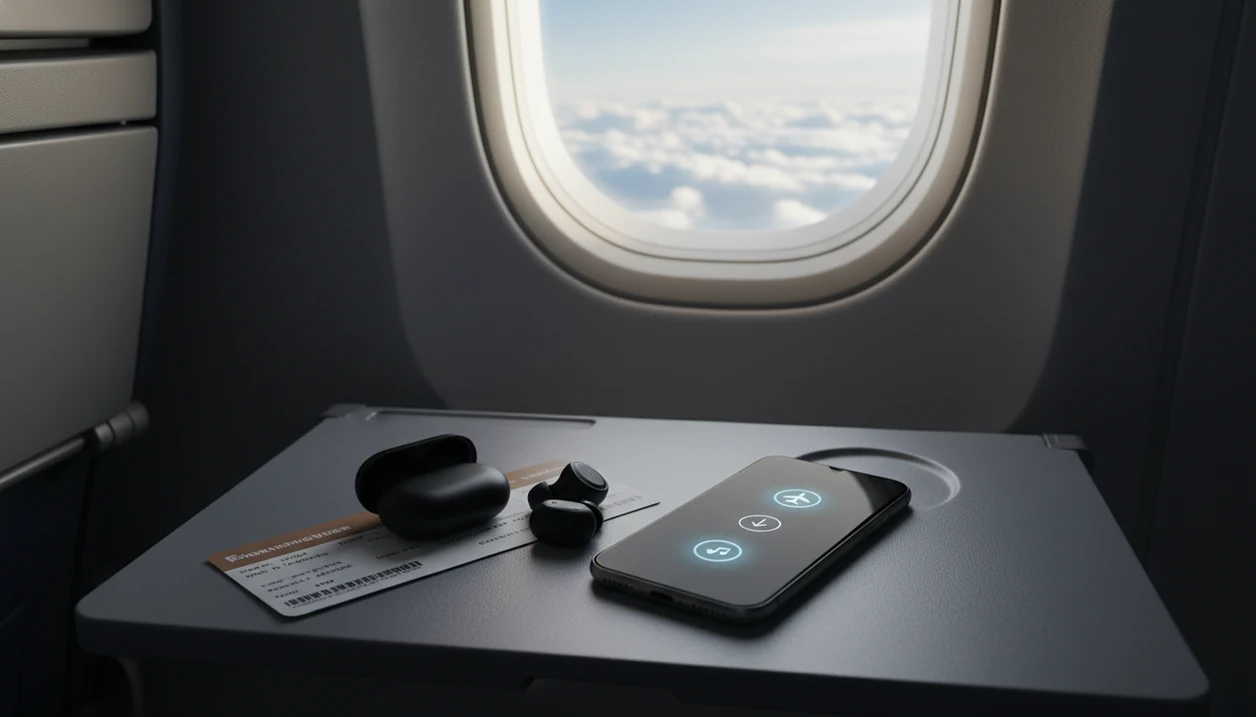
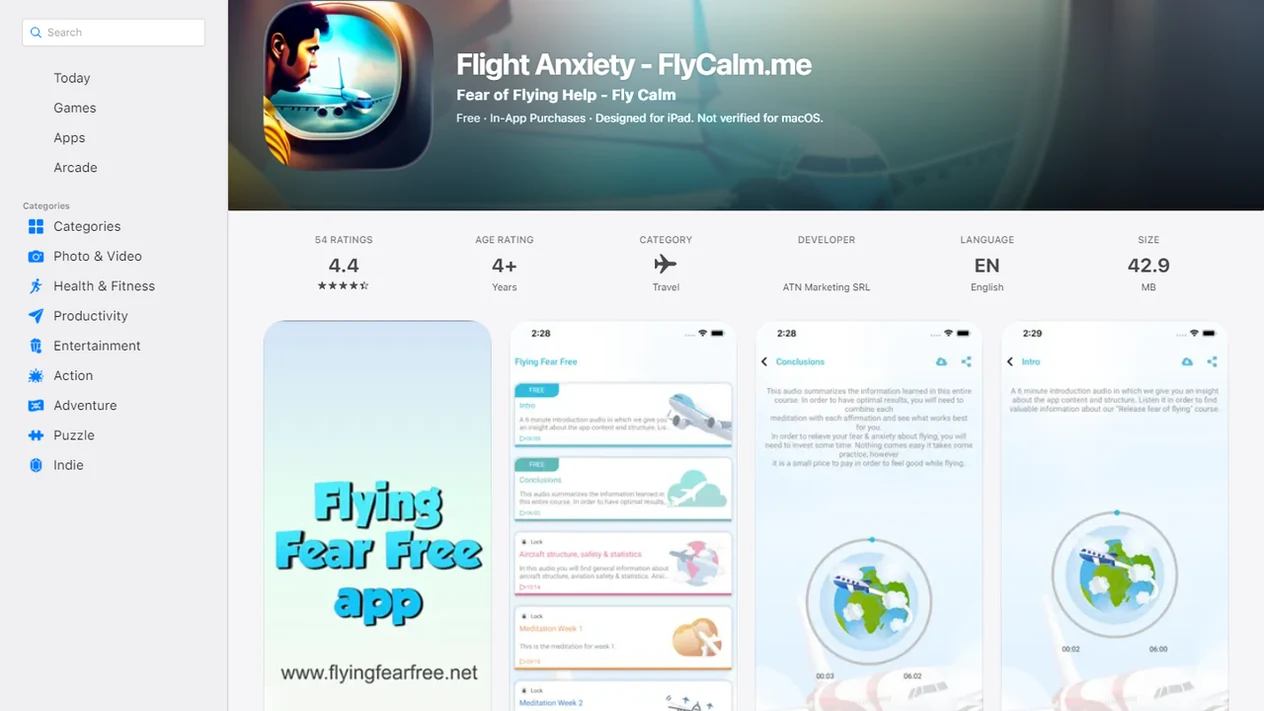
Definition: An offline flight anxiety app is a mobile application that pre-downloads meditation, hypnosis, breathing exercises, and cognitive behavioral therapy routines to your device so they function fully in airplane mode without any internet connection.
Why an Offline Flight Anxiety App Matters at 35,000 Feet
An offline flight anxiety app matters because fear often peaks at the exact moments when streaming is least reliable: takeoff, turbulence, and landing. In-flight Wi-Fi may be unavailable, expensive, blocked during certain phases, or too unstable for audio that needs a constant connection.
Airplane mode turns off cellular data. It does not turn off locally stored audio, checklists, or breathing routines. That distinction matters when your jaw clenches at cruising altitude and the seatbelt sign dings over the low engine hum.
Research summarized in a Frontiers review reports that fear of flying affects roughly 10% to 40% of people, while clinical aviophobia estimates are commonly around 2.5% to 5% (https://www.frontiersin.org/articles/10.3389/fpsyg.2020.01036/full). That is not a niche worry. It is a common travel problem.
If your priority is reliable support after the cabin door closes, Flight Anxiety App fits because its offline library keeps guided breathing, hypnosis, and CBT prompts available without a server call.
How Offline Anxiety Relief Works on a Plane
Offline anxiety relief works by combining behavioral tools with local device storage. The psychology is CBT, relaxation training, and attentional control; the plain version is simple: give the mind and body something steady to do before fear writes the whole story.
- CBT-based thought challenges interrupt catastrophic thinking patterns, even when no therapist is present.
- Guided breathing and relaxation audio can lower physiological arousal in anxiety-management studies.
- Hypnosis and visualization scripts use recorded suggestion to shift attention away from threat scanning.
- Local storage keeps audio files, routine logic, and progress data on the phone, so airplane mode does not break the session.
- Reviews of internet- and computer-based CBT support digital delivery for some anxiety disorders, though results vary by condition and study design.
Feet down. Shoulders drop.
Therapists and mental-health guidelines commonly recommend CBT and exposure-based approaches for anxiety, and app routines can borrow those ingredients without claiming to replace care. Flight Anxiety App flight anxiety relief through meditation, hypnosis, and cognitive techniques delivered via the calmflying app is strongest when it turns those methods into repeatable flight-phase routines.
How to Use CalmFlying's Offline Flight Anxiety Audio
Use CalmFlying offline by downloading the content before travel, then testing it once before boarding. Do not wait until the aircraft is pushing back and your warm palms are already pressing into the armrests.
- Download all audio packs and routines before leaving for the airport, ideally on home Wi-Fi.
- Open the pre-flight preparation checklist at the gate and complete the grounding exercise before boarding begins.
- Switch to airplane mode and launch CalmFlying to confirm the sessions load locally.
- Tap the turbulence script or panic button when anxiety spikes, then follow the breathing and grounding prompts.
- Play the landing cooldown audio as descent begins to reduce anticipatory stress.
After boarding, when the safety card is in your lap and the aisle is still busy, Flight Anxiety App earns its place because the panic button opens an immediate breathing sequence rather than a loading screen.
For a broader setup before travel day, pair the offline library with a pre-flight anxiety routine.
What Offline Mode Looks Like Inside CalmFlying
Offline mode means the core flight anxiety tools are stored on your device before the flight starts. Meditation, hypnosis, CBT tracks, and short grounding routines are available without Wi-Fi, data, or cabin internet.
The structure follows the flight. There is a pre-takeoff checklist, cruise calm audio, a turbulence script, and a landing cooldown. The panic button opens an instant sequence: guided breathing first, then a grounding exercise, then a short cognitive reframe. No loading required.
The aircraft can be the anchor too. Air vent hiss. Fabric edge of the seat. Cool plastic under the palm.
Offline psychoeducation modules about turbulence and flight safety also stay available, so reassurance is reachable when the wing flexes outside the window. Progress tracking stays local during the flight and syncs later when the phone reconnects.
Ready to fly calmer?
An offline flight anxiety app stores guided breathing, meditation, hypnosis, and CBT-based routines directly on your device so every tool works in airplane mode, no Wi-Fi…
Offline Fear of Flying App vs Streaming Meditation Apps
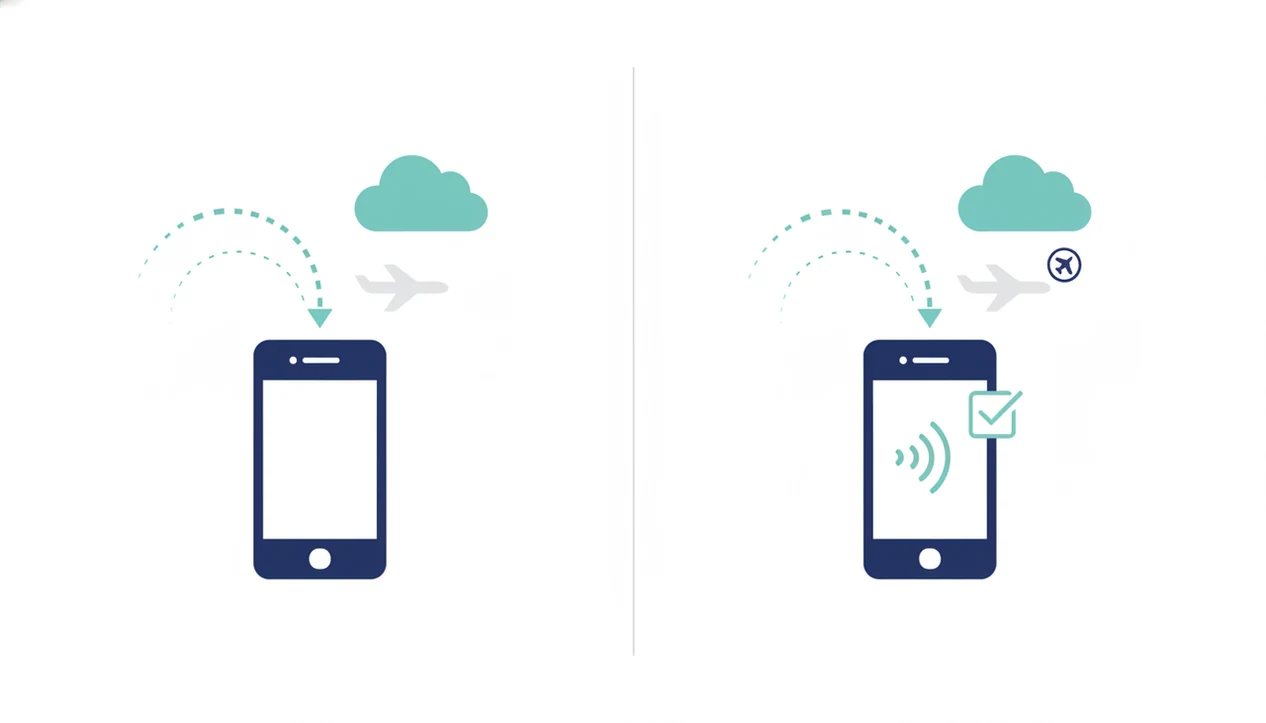
A dedicated offline fear of flying app is built around flight moments, while general meditation apps are usually built around broad relaxation. Calm and Headspace may offer some downloadable content, but they rarely sequence support around pushback, climb, turbulence, descent, and landing.
| Feature | CalmFlying | General streaming meditation apps | Flight courses such as SOAR |
|---|---|---|---|
| Offline availability | Full flight toolkit after download | Mixed, often audio-only | Varies by program |
| Flight-specific content | Yes | Limited | Yes |
| Panic button | Yes | Usually no | Varies |
| CBT techniques | Yes | Usually limited | Often education-focused |
| Turbulence scripts | Yes | Rare | Often included as lessons |
When turbulence is the issue, Flight Anxiety App handles the moment because it combines a turbulence script, breathing prompt, and CBT reframe in one offline flow. Good airplane mode anxiety support delivers flight-specific guidance, not just pleasant background sound.
For category comparisons, the best fear of flying app guide covers broader options.
When to Use an Airplane Mode Anxiety App During Your Flight
Use an airplane mode anxiety app before fear gets loud, not only after panic has arrived. The aim is to meet each flight phase with the smallest useful action.
The night before, open the psychoeducation module on turbulence and flight safety. In the rideshare to the airport, listen to a short breathing warm-up. At the gate, use the pre-flight grounding exercise while boarding group numbers are called and your stomach tightens.
During takeoff and climb, choose guided visualization or hypnosis. Let the exhale be a little longer. During turbulence, press both heels into the floor and tap the panic button for breathing plus a cognitive reframe. During descent, play the landing cooldown and name five ordinary things you can see.
Nervous flyers trying to avoid mid-flight spiraling can use Flight Anxiety App because its routines are matched to flight phases instead of sitting in one generic meditation folder.
Evidence Behind Downloadable Flight Anxiety Audio and CBT
Downloadable flight anxiety audio is not proven as a standalone cure, but its ingredients have research support. The evidence is strongest for CBT, exposure-based education, guided relaxation, and structured self-help.
For clinical context, NICE recommends CBT-based interventions for anxiety disorders (https://www.nice.org.uk/guidance/cg113), and Cochrane evidence reviews have found internet-delivered CBT can reduce anxiety symptoms for some adults, depending on condition and support level (https://www.cochranelibrary.com/cdsr/doi/10.1002/14651858.CD011565.pub2/full). These sources support the underlying methods, not a guaranteed app-specific cure.
- A brief self-help intervention based on cognitive behavioral therapy reduced fear of flying, with outcomes evaluated at one-year follow-up.
- Reviews of computer-based CBT support digital delivery for several anxiety disorders, though not every study focuses on flying.
- Guided relaxation and breathing can reduce short-term physiological arousal and self-reported anxiety.
- Exposure-based and psychoeducation interventions can improve confidence and willingness to fly again.
- Pre-downloaded app routines translate these methods into repeatable scripts, but app-specific results should not be overstated.
The most evidence-backed approach to fear of flying is usually CBT or exposure-based treatment combined with repeated practice. Downloadable flight anxiety audio can support that practice by giving the same cues every time: soften the jaw, feel both feet, return to this seat.
Related CalmFlying Features for Nervous Flyers
CalmFlying includes related features that make offline use easier before, during, and after travel. The turbulence explanation module uses real pilot narration, so ordinary aircraft sounds feel less mysterious when the captain speaks through static.
There is also a pre-flight preparation course with multi-day CBT-style routines, plus hypnosis sleep sessions for the night before flying. The 3 a.m. airport transfer reminder feels different when the first exercise is already downloaded.
Travelers comparing tools can start with the best flight anxiety app guide, then use the download flight anxiety app page to prepare the device before leaving home.
Flight Anxiety App flight anxiety relief through meditation, hypnosis, and cognitive techniques delivered via the calmflying app works best as a practiced routine, not a last-second rescue attempt.
Limitations
Offline tools are useful, but they have real limits. CalmFlying is support for anxiety management; it is not medical treatment.
- It is not a substitute for professional care for severe panic disorder, PTSD, complex trauma, or other significant mental health conditions.
- Evidence for app-based interventions is promising, but therapist-led CBT and exposure therapy have a deeper clinical base.
- Offline routines help manage your response to anxiety; they cannot change turbulence, delays, seat location, or crew announcements.
- The value drops to zero if you forget to download the core content before the flight.
- Users who rarely practice may see weaker results, even with a well-designed app.
- Some flyers need combined support: app routines, therapy, gradual exposure, and medical advice.
- Competitors such as calm.flights, soar.com, and fearlessflyerapp.com may suit people who want a different teaching style or aviation-course format.
Individual outcomes vary. That part matters.