
What To Do During Turbulence Anxiety In The Cabin
When you feel turbulence anxiety, stay seated with your belt fastened and follow a short nervous-system routine: lengthen your exhale, release muscle tension, ground through your senses, and label scary thoughts as thoughts rather than facts. This is what to do during turbulence anxiety because it gives your body and mind specific safety signals while the cabin feels unpredictable.
> Definition: Turbulence anxiety is the fear response that happens when aircraft movement triggers your nervous system’s alarm system, even when the aircraft remains designed and operated to handle turbulence safely.
TL;DR
- Use a timed in-seat protocol: breathe, relax, ground, reframe, and anchor attention.
- Longer exhales, unclenched muscles, and sensory grounding help shift the body out of fight-or-flight.
- Queued audio support can provide guided meditation, hypnosis, breathing exercises, and cognitive techniques before and during the flight.
Turbulence Anxiety At A Glance: The 4-Minute In-Seat Safety Protocol
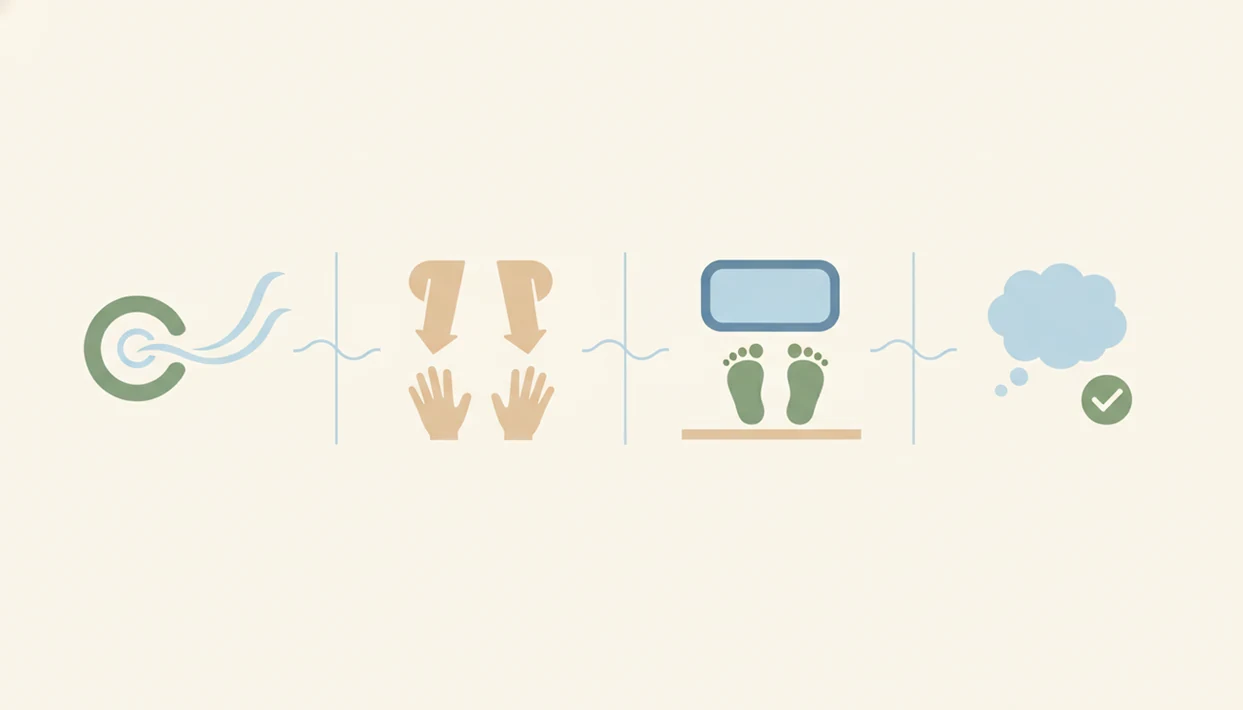
The quickest turbulence anxiety protocol is: stay seated, keep your seat belt fastened, and spend four minutes regulating your body before trying to distract your mind. Start with the body. It is usually louder than logic when the cabin bumps.
Use this timing in your seat: 60 seconds of longer-exhale breathing, 90 seconds of muscle release, 60 seconds of sensory grounding, and 30 seconds of fact-based thought labeling. If the seat belt sign is on, do not stand up to “shake it off.” Your job is smaller: feet down, belt on, shoulders against the seat.
The pocket check is real.
If you use audio support, queue a turbulence routine before takeoff. Airport Wi-Fi often fades right when the gate number changes on the screen, and thinking gets harder once the cabin bins start clicking shut.
Turbulence Anxiety Body Signals: Stomach Drops, Gripping, And Racing Thoughts
Turbulence anxiety is a real alarm response with an exaggerated danger prediction; the fear feels true even when the movement is not evidence that the aircraft is unsafe. Your body can be reacting honestly and still misreading the situation.
Common signals include a stomach drop, tight hands, shallow breathing, heat in the face, dizziness, and racing thoughts. Some people grip the armrest so hard their fingers ache after landing. Others stare at the wing or watch the flight attendants’ faces for clues.
Discomfort is not the same as danger.
Large U.S. surveys have found that anxiety disorders and specific phobias are common, including situational fears such as flying. The National Institute of Mental Health estimates lifetime prevalence of specific phobia among U.S. adults at 12.5% source.
Five Facts About Turbulence Anxiety Tips That Matter Most
- Turbulence usually feels more dangerous than it is for a modern airliner. The passenger’s body feels sudden motion, but aircraft are designed and operated with turbulence in mind.
- The main target is the alarm response, not every scary thought. For many nervous flyers, calming the body first makes thinking clearer.
- Longer exhales and slow diaphragmatic breathing can reduce sympathetic arousal. Controlled breathing has been associated with lower anxiety and sympathetic activity in clinical and laboratory research source.
- CBT-style thought labeling can interrupt catastrophic loops. “I am having the thought that…” creates space between a fear and a fact.
- Between-flight practice improves access during flight. A skill rehearsed on the sofa is easier to find when the flaps whir beside the wing.
For turbulence anxiety, body regulation is often more useful than reassurance alone because the nervous system needs physical safety cues before logic can land.
Nervous System Mechanics Behind Turbulence Anxiety Coping
Turbulence can activate fight-or-flight because the brain treats unexpected motion as possible threat. The amygdala, a threat-detection system, reacts faster than your reasoning brain. In plain language: your body may hit the alarm before you have time to review the facts.
Longer exhales, relaxed muscles, and sensory orientation send “I am not escaping right now” signals back to the nervous system. Your breathing rate slows. Your grip softens. Your attention returns to the cabin instead of an imagined future scene.
Cognitive defusion adds one more layer. Instead of “the plane will fall,” say, “I am having the thought that the plane will fall.” That small wording change matters. It turns a prediction into a mental event.
Guided meditation and hypnosis can support the same process through attention narrowing, body regulation, and rehearsed coping. A guided flight-anxiety routine can give you practiced cues, not a guarantee that fear will vanish.
Before Turbulence Starts: Prepare Your Calm During Turbulence Plan
“What should I do before turbulence starts?” Prepare the routine while your brain is still online. Download or queue calming audio before boarding, because aircraft Wi-Fi and airport signal can be unreliable.
Choose one seat-belt phrase before you fly: “Belt fastened, body supported, aircrew working.” Put your phone, earbuds, water, and one grounding object within reach. A smooth stone, a ring, or the edge of your boarding pass can work. Nothing dramatic.
Practice your breathing rhythm on the ground for two minutes. Try it during the rideshare to the airport, or while waiting in the security line. The aim is familiarity, not perfect calm.
If panic symptoms are part of your pattern, our in-flight panic attack guide covers what to do when fear spikes beyond ordinary turbulence nerves. Regulation is still the goal. Fearless is not required.
Step 1: Use Longer-Exhale Breathing For Turbulence Anxiety
Start with both feet on the floor and your shoulders supported by the seat. Let the seat carry some weight. If your forehead is cooled against the window, stay there only if it helps you feel oriented.
Breathe in gently for 3 or 4 counts. Exhale for 5 or 6 counts. Do not force a huge breath, and do not hold your breath at the top. Forceful breathing can make dizziness worse for some people.
Use 6 to 10 cycles before judging whether it worked. Most people check too early, then decide they failed.
Controlled breathing exercises, including slow diaphragmatic breathing, have been linked with reduced anxiety and lower sympathetic nervous system activity. Clinicians typically recommend slower breathing as one tool for anxiety regulation, especially when it is gentle and not used as a struggle for instant control. For a longer version, use this breathing exercise for panic on plane.
Step 2: Release Cabin Muscle Tension During Turbulence Anxiety
The usual turbulence bracing pattern is easy to miss: jaw locked, hands clenched, stomach tight, thighs pressed together, toes curled inside shoes. That posture tells the brain, “brace for impact,” even when you are safely seated.
Scan from face to feet. Soften your tongue from the roof of your mouth. Drop your shoulders one inch. Uncurl your fingers from the armrest and rest your palms on your thighs or the seat cushion. If it feels comfortable, gently tense your hands for three seconds, then release.
Do not turn this into a performance.
Loosening the body does not mean you like the turbulence. It tells the brain the situation is tolerable enough to stop fighting every bump. I often suggest practicing this once before pushback, when the aircraft is still quiet and the safety card is staring back from the seat pocket.
Step 3: Ground Your Senses To Stay Calm During Turbulence
Grounding works by pulling attention from imagined future danger into present-moment data. Use a modified 5-4-3-2-1 exercise that fits an airplane seat.
Name five things you can see, such as a seatback logo, a tray latch, a shoe, a light, or a blue jacket. Notice four contact points: seat support, floor pressure, belt contact, and your back against the cushion. Identify three sounds, including air vent noise or nearby voices. Notice two body sensations that are not danger, then take one slower exhale.
Keep your eyes open if closing them makes the motion feel bigger. Some nervous flyers do better with one repeated anchor, such as thumb-to-finger pressure or counting blue objects in the cabin.
For fear of turbulence coping, grounding usually works best when it is concrete, repetitive, and boring enough to compete with catastrophic imagination.
Step 4: Reframe Fear Of Turbulence Thoughts With CBT-Style Labels
Use the sentence: “I am having the thought that the plane will fall.” Then replace prediction language with fact-based language: “This feels uncomfortable; aircraft are designed for turbulence; the crew is trained for this.”
Do not argue aggressively with fear. If you debate every sensation, you may start monitoring the aircraft even more closely. That keeps the alarm loop running.
Short cue cards help. So do phone notes prepared before boarding, especially if your hands shake once the bumps begin. Write three lines before the flight, not during the spiral.
A randomized trial of self-help CBT for fear of flying found that structured psychological techniques helped more participants take a flight after treatment than a control condition source. The most common medically supported way to reduce flight phobia is structured CBT-style practice combined with gradual exposure and in-flight coping skills.
How To Use A 4-Minute Turbulence Anxiety Routine In Your Seat
Use this routine when the seat belt sign comes on, when the aircraft starts bumping, or when your mind starts scanning for danger. If you have only five minutes and 18% battery in the departure lounge, save the steps in a note before boarding.
- Set a 4-minute mental timer or follow a guided Flight Anxiety App track if you queued one before takeoff.
- Breathe with longer exhales for 60 seconds using a 3-to-5 or 4-to-6 count.
- Scan and release muscles for 90 seconds from jaw, hands, stomach, thighs, and toes.
- Ground through senses for 60 seconds using seat support, floor pressure, belt contact, air vent, and cabin voices.
- Label and reframe one scary thought for 30 seconds with “I am having the thought that…” and one fact-based sentence.
- Repeat the routine instead of checking whether fear has disappeared.
The routine is working if you are more able to stay seated, listen, and respond.
Common Mistakes To Avoid During Turbulence Anxiety
The biggest mistake during turbulence anxiety is trying to regain control in ways that feed the alarm. Stay physically safe first, then use one simple routine long enough for your body to catch up.
- Keep your seat belt fastened and stay seated whenever the seat belt sign is on. Standing, pacing, or reaching into the overhead bin may feel like “doing something,” but it works against the safest instruction in the cabin.
- Stop repeated safety-checking of the wing, the crew’s facial expressions, or the flight map. One glance for orientation is different from scanning every few seconds for proof.
- Soften your breathing if deep breaths make you lightheaded. Use smaller inhales and longer, easy exhales instead of forcing air.
- Delay the debate with every frightening thought. While your body is still alarmed, arguing can turn into more monitoring. Label the thought, then return to the routine.
- Repeat one method for several minutes before switching. Technique-hopping every few seconds teaches your brain that nothing is safe enough to stay with.
Common Myths About Staying Calm During Turbulence
A scary jolt does not mean the plane is about to break. Turbulence can be deeply uncomfortable without being a structural emergency for a modern airliner.
Gripping the armrests is not the only way to cope. It may feel protective, but it often feeds the body’s alarm message. Try soft hands, supported feet, and a longer exhale instead.
Meditation and hypnosis are not magic, and they are not useless. They can affect attention, breathing pace, muscle tone, and threat focus. That is nervous-system work, not wishful thinking.
Another myth: if you still feel anxious, the technique failed. No. Success means staying functional and regulated enough to ride out the moment. If you want an audio-led option, an app that talks you through turbulence can reduce the need to remember every step while stressed.
0-10 Signs Your Turbulence Anxiety Tips Are Working
Rate your distress from 0 to 10 before the routine, then again after four minutes. Do not demand a drop from 9 to 0. A shift from 8 to 6, or from “I cannot think” to “I can follow one instruction,” counts.
Signs of regulation include slower breathing, less gripping, better ability to hear announcements, shorter thought spirals, and fewer safety-checking behaviors. You may stop watching the flight attendant every three seconds. You may unclench your toes without noticing.
Progress comes in waves.
After landing, log what helped. Write down the breathing count, grounding anchor, and cue phrase that worked best. Between-flight practice strengthens recall later because your brain has a familiar path to follow. If symptoms linger after travel, compare them with common flight anxiety side effects so you can plan the next flight with clearer expectations.
CalmFlying Tools For Fear Of Turbulence Coping
A flight anxiety app can provide meditation, hypnosis, breathing exercises, and cognitive techniques for nervous flyers. App-based audio can give you something concrete to do when turbulence makes thinking feel crowded.
Useful tools include:
- Breathing tracks: timed prompts for longer exhales when you are seated and tense.
- Guided meditation: attention anchors for boarding, takeoff, turbulence, and descent.
- Brief hypnosis audio: rehearsed relaxation cues for people who respond well to imagery.
- Cognitive techniques: short reframes for catastrophic predictions and safety-checking loops.
These tools can supplement preparation, aviation reassurance, and professional care when needed. They should not be treated as a cure or a substitute for therapy if fear of flying is severe. If you are comparing app options, the best fear of flying app for turbulence guide focuses on features rather than promises.
Limitations
In-seat turbulence anxiety techniques can help, but they have clear limits.
- They are not a substitute for professional evaluation if anxiety, avoidance, or panic attacks seriously affect your life.
- No breathing, grounding, hypnosis, or meditation routine can remove turbulence or guarantee a symptom-free flight.
- Some medical conditions may require adapted breathing work under clinician guidance, especially respiratory or cardiac concerns.
- App-based interventions have less fear-of-flying evidence than therapist-led CBT programs.
- Trauma histories, panic disorder, and respiratory conditions can change the safest coping plan.
- If a crew instruction conflicts with your coping plan, follow the crew instruction first.
- If you feel faint, have chest pain, or experience unfamiliar severe symptoms, ask cabin crew for help.
A practical next step is not to “beat” turbulence anxiety forever. It is to build a repeatable plan, then get professional support if your fear keeps shrinking your life.
FAQ
Is turbulence anxiety normal for nervous flyers?
Yes. Turbulence anxiety is common among nervous flyers and does not mean you are weak, irrational, or unsafe to fly.
Can turbulence cause a plane to crash?
Modern airliners are designed and operated to handle turbulence, and pilots use procedures to manage comfort and safety. Severe events are taken seriously, but ordinary turbulence is not usually a structural emergency.
What helps turbulence anxiety fastest while I am seated?
The fastest in-seat steps are longer exhales, muscle release, sensory grounding, and CBT-style thought labeling. Keep your seat belt fastened while you use them.
Should I close my eyes during turbulence?
Close your eyes only if it helps you feel steadier. If it makes the motion feel bigger, keep your eyes open and ground through stable cabin cues.
Why does turbulence feel like the plane is falling?
Turbulence can create stomach-drop sensations because your body detects sudden motion quickly. Anxiety then interprets that sensation as danger, even when it is discomfort.
Do pilots worry about turbulence the same way passengers do?
Pilots generally treat turbulence as an operational comfort and safety-management issue. Passengers often experience it more emotionally because they lack control and cockpit context.
Can breathing exercises stop a panic attack during turbulence?
Breathing exercises can reduce arousal and help you ride out panic symptoms. They may not stop panic instantly, especially if symptoms are already intense.
Does hypnosis help with flight anxiety and turbulence fear?
Hypnosis may support relaxation, attention control, and rehearsal of coping cues. It is usually most useful as part of a broader plan that includes breathing, grounding, and cognitive techniques.
When should I seek professional help for turbulence anxiety?
Seek professional help if you avoid needed flights, have repeated panic attacks, or feel major life impairment from flying fear. A clinician can assess whether CBT, exposure work, medication discussion, or another treatment path fits.