Airport Anxiety Before Boarding: What to Do at the Gate
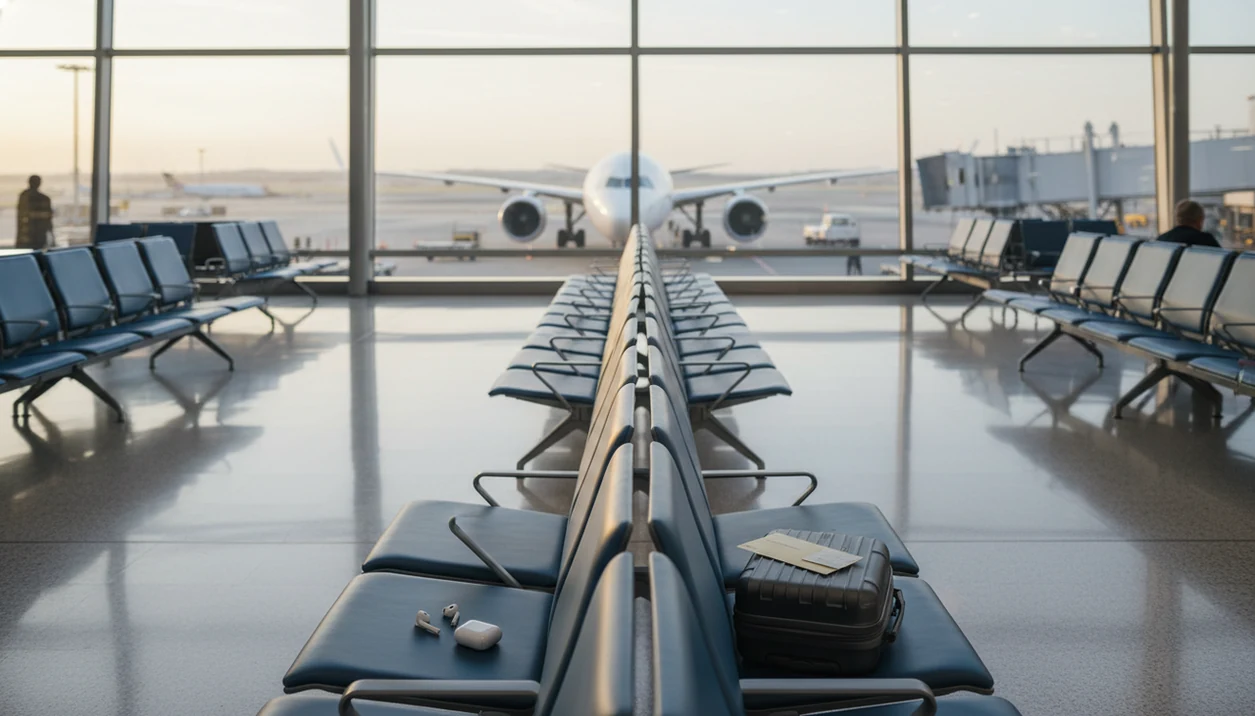
To manage airport anxiety before boarding, follow a simple gate routine: arrive with enough buffer, reduce uncertainty, use grounding or app audio, plan one bathroom break, and limit reassurance checking. The goal is not to feel perfectly calm; it is to keep your anxiety workable until you step onto the plane.
> Definition: Airport anxiety before boarding is the anxious, wired, or panicky state that happens in the terminal or at the gate before a flight, often driven by waiting, uncertainty, crowds, bodily symptoms, and fear-of-flying thoughts.
- Use the 30–60 minutes before boarding as a structured routine, not as open-ended worry time.
- Pair practical gate planning with breathing, grounding, CBT reframing, or guided CalmFlying audio.
- Avoid alcohol, last-minute new medication, and endless reassurance checking because they can make anxiety harder to manage.
Airport Anxiety Before Boarding: The 5 Facts Nervous Flyers Need
- Airport and gate anxiety can feel physical. Racing thoughts, tight chest, nausea, sweating, irritability, and the urge to leave the airport are common anxiety patterns, not proof that something is medically wrong.
- The waiting can feel worse than the flight. Many nervous flyers feel their highest anxiety in security lines or at the gate, before takeoff has even started. The open suitcase on bedroom carpet can begin the spiral hours earlier.
- Fear of flying is common. In a Chapman University Survey of American Fears, 40% of U.S. adults reported being afraid of flying, and about 12% reported being very afraid or extremely afraid: https://www.chapman.edu/wilkinson/research-centers/babbie-center/survey-american-fears.aspx
- Skills work better when practiced early. CBT, breathing, meditation, and app-based tools have research support, but the airport is not the ideal place to learn them from scratch. A pre-flight anxiety routine gives the gate routine more grip.
- The realistic target is workable discomfort. For nervous flyers, the goal is often to board while anxious, not to erase every symptom before boarding begins.
Not calm. Capable.
How Gate Anxiety Before Flight Works in the Brain and Body
Gate anxiety before flight is a threat-response loop where uncertainty triggers body sensations, body sensations trigger catastrophic thoughts, and checking or avoidance briefly lowers fear before strengthening it again.
Airport cues feed that loop. Boarding announcements, crowds, security bins, delays, gate changes, and visible aircraft can all tell the brain, “Pay attention.” Then the body joins in. You notice dizziness, stomach churn, or chest tightness, and the monitoring makes each symptom louder.
That is anticipatory anxiety in plain clothes.
CBT-style reframing works by interrupting the thought-body-behavior cycle. Instead of “My tight chest means I can’t fly,” the replacement might be, “This is anxiety arousal, and I can take the next airport step.” A structured audio exercise can walk a nervous flyer through meditation, breathing, hypnosis, or cognitive reframing without making the gate feel like a full therapy session.
Pre Boarding Anxiety Requirements Before You Reach the Gate
Pre boarding anxiety is easier to manage when the gate period is not also document search, battery panic, and seat-choice stress. Arrive early enough to avoid rushing, but not so early that you create two extra hours of worry time.
Before leaving home, download your boarding pass, airline app, app audio, and any needed documents. Put headphones, charger, ID, medication you already use, and passport where your hand can find them without unpacking half the bag. If seat choice is available, pick it before the airport.
Small items matter at the gate: water after security, a snack, gum, layers, and a written coping card. If you’re using your phone as a coping tool, this is also when how to prepare for flight anxiety with phone becomes practical, not theoretical.
Do not try a new medication, supplement, or strong sedative for the first time at the airport.
How to Use a 45-Minute Airport Anxiety Before Boarding Routine
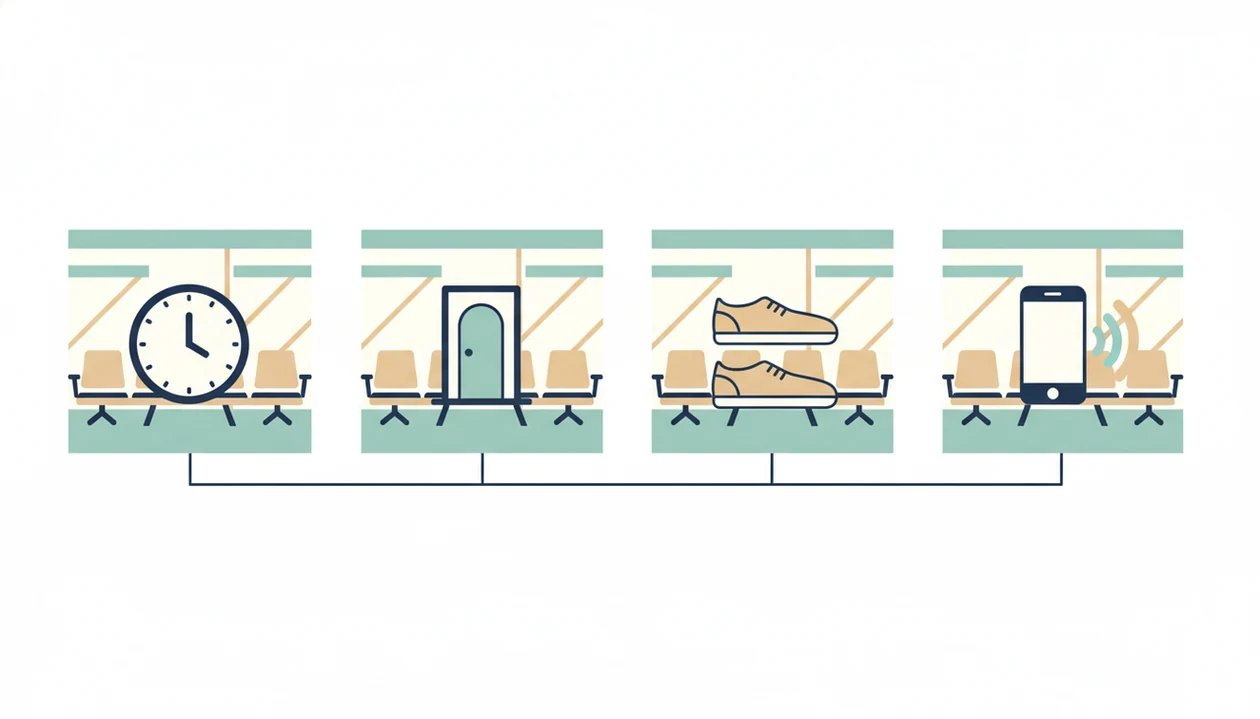
Use the final 45 minutes as a routine, not a mood test. If boarding is delayed, repeat the middle steps instead of restarting the whole worry cycle.
- Set one official check. Confirm boarding time, gate, and group once, then stop refreshing unless an announcement or airline notification changes something.
- Choose a lower-stimulation seat. Sit near the gate, but not directly inside the boarding crowd. A side wall or quieter row usually works better.
- Start a short audio track. Use a 10–15 minute Flight Anxiety App breathing, meditation, hypnosis, or cognitive exercise. Long tracks can feel like another task.
- Take one planned bathroom break. Do it before boarding groups begin, not after panic has turned it into an emergency.
- Use 5-4-3-2-1 grounding. When the boarding announcement starts, name five things you see, four you feel, three you hear, two you smell, and one you taste.
- Board when called. Do not wait for anxiety to disappear. That is not the boarding requirement.
Step 1: Reduce Airport Stress Fear of Flying Triggers Early
Reduce airport stress fear of flying triggers by separating practical airport tasks from fear coping. Check-in, security, and gate finding are logistics. Breathing, grounding, and reframing are anxiety skills.
Security can become exposure practice. The bins, queue, scanner, and repacking moment are uncomfortable, but they are not evidence that the flight is unsafe. After security, pause for one short reset before finding the gate. Put both feet on the floor, soften your jaw, and exhale longer than you inhale.
Keep the body steady. Eat something familiar, go easy on caffeine, sip water, and use the bathroom before the gate gets crowded. A weather app checked under blankets at 4 a.m. rarely improves the flight, and airport doom-scrolling is worse. Avoid turbulence videos, incident searches, and Reddit panic threads once you are inside the terminal.
Step 2: Calm Gate Anxiety Before Flight With Grounding and App Audio
Calm gate anxiety before flight with short, timed exercises rather than a long attempt to relax perfectly. Mobile phone-based mental health interventions have been associated with reductions in anxiety symptoms in systematic reviews, which supports using short app-delivered breathing, mindfulness, and CBT exercises as a supplement rather than a cure: https://www.ncbi.nlm.nih.gov/pmc/articles/PMC6606670/
Use the tool that matches the symptom. Breathing is best for body arousal, grounding is best for panic spikes, and CBT reframing is best for what-if thoughts. Tools like Flight Anxiety App can guide those choices without turning the gate into a therapy session.
Effective flight anxiety relief through meditation, hypnosis, and cognitive techniques delivered via the calmflying app should give nervous flyers a repeatable coping sequence, not a promise that fear will vanish on command.
Breathing for body symptoms
Use breathing when your chest feels tight, your fingers tingle, or your palms feel warm on the armrests in your imagination before you even board. Longer exhales signal “stand down” to the nervous system.
Grounding for panic spikes
Use grounding when panic feels fast and unreal. Count rows to the exit sign, name colors around the gate, or press your feet into the floor.
CBT reframing for what-if thoughts
Use CBT reframing when the mind starts rehearsing disaster. For airport anxiety, the most useful reframe is usually, “Anxiety is making predictions, not giving instructions.”
Step 3: Limit Reassurance Checking During Pre Boarding Anxiety
Does repeatedly checking flight details calm pre boarding anxiety? It can calm you for a minute, but it often trains the brain to demand another check.
Reassurance checking means repeatedly checking weather, aircraft type, airline app, departure boards, pilot announcements, flight maps, or online forums to feel safe enough to board. Sensible awareness is different. You need the gate, time, boarding group, and official updates. You do not need twelve searches about aircraft sounds before the boarding queue forms.
Use this rule: one scheduled check, then only respond to official announcements or app notifications. Replace the next checking urge with a coping card phrase, such as, “I can be anxious and still board safely.”
That sentence is short for a reason. At the gate, short is usable.
Common Myths About Airport Anxiety Before Boarding
- Myth 1: Intense airport anxiety means you should not fly. Many anxious flyers travel safely while uncomfortable, especially when they use practiced skills and a structured gate routine.
- Myth 2: Airport bar drinks are the fastest reliable solution. Alcohol can impair judgment, disrupt sleep, worsen dehydration, and make panic harder to interpret. It is not a dependable coping plan.
- Myth 3: Breathing and meditation are too soft for real anxiety. Clinicians typically recommend skills such as paced breathing, exposure, and CBT-based reframing for anxiety because they target arousal and avoidance patterns.
- Myth 4: If panic starts at the gate, nothing can be done. You can slow your exhale, ground through your senses, move to the next small task, and ask airport or airline staff for practical help if needed.
- Myth 5: Repeated reassurance proves the flight is safe. It usually proves anxiety wants another answer. Practiced skills, not endless certainty, are the safer alternative.
Evidence Behind Airport Anxiety Coping Techniques
The strongest evidence behind airport anxiety coping techniques supports CBT and gradual exposure for anxiety and avoidance. Breathing, grounding, and app audio can help in the moment, but they are supports, not replacements for care when fear is severe.
- Use CBT to challenge threat predictions. CBT targets the loop between catastrophic thoughts, body symptoms, and avoidance. For flying fear, exposure therapy adds careful practice with feared cues so the brain learns, through repetition, that discomfort is not danger.
- Practice paced breathing before the gate. Slow, steady breathing can reduce short-term physiological arousal, especially when the exhale is unhurried. It will not prove the flight is safe; it helps your body stop treating every sensation as an alarm.
- Treat apps as guided support. App-based tools can cue breathing, meditation, CBT prompts, or grounding when your mind is busy. They are not equivalent to assessment, diagnosis, or therapist-led treatment.
- Be cautious with hypnosis claims. Hypnosis may feel useful for some nervous flyers, but its evidence base for fear of flying is weaker than CBT and exposure.
- Avoid impulsive alcohol or medication fixes. Authoritative health guidance generally cautions against mixing alcohol with sedatives, using medication without medical advice, or trying a new drug right before travel.
Boarding Verification Checklist for Airport Stress Fear of Flying
Use this checklist once. Its job is to confirm readiness without feeding airport stress fear of flying.
- Gate confirmed
- Boarding group known
- Bathroom done
- Water or snack ready
- Headphones accessible
- App audio queued
- ID and boarding pass reachable
- Bag zipped and manageable
Then do a body check: “Tight chest, warm face, busy thoughts.” Label the symptoms without treating them as danger. Before standing, use one cognitive reframe: “I do not need to feel fully calm to take the next step.”
Boarding is the next small action, not a test of bravery. If your anxiety has dropped from a 9 to a 7, that still counts. If it stayed at a 9 but you stopped checking, that counts too.
Limitations
Self-guided tools can help with gate anxiety before flight, but they have clear limits.
- Self-guided apps and audio tools can support anxiety management, but they are not a substitute for professional treatment when anxiety is severe, disabling, or linked to panic disorder, trauma, OCD, substance use, or other mental health concerns.
- Not every technique works for every nervous flyer. Meditation, hypnosis, breathing, and CBT exercises may require trial and error.
- Self-guided hypnosis has less direct evidence for fear of flying than therapist-led CBT, so cure claims are not appropriate.
- Airport delays, gate changes, cancellations, weather events, and security disruptions cannot be controlled by any routine.
- New medication, supplements, or alcohol should not be used impulsively right before boarding. Medication decisions belong with a qualified clinician in advance.
- If symptoms include severe chest pain, fainting, or a medical emergency concern, seek airport medical assistance rather than assuming it is only anxiety.
- If sleep is the main trigger, a separate plan for sleep before flight anxiety may matter more than gate tactics alone.
When Airport Anxiety Needs Professional Help
Airport anxiety needs professional help when it repeatedly stops you from traveling, causes panic attacks, or brings up trauma symptoms such as flashbacks, nightmares, or feeling unsafe long after the airport is over. Getting help is not a failure of willpower; it is the right tool for anxiety that has become too large for gate tactics alone.
Use a simple safety sort at the airport:
- Separate anxiety from possible medical danger. Racing thoughts, shaky hands, nausea, and a tight throat can fit anxiety, but severe chest pain, fainting, one-sided weakness, or symptoms that feel medically unsafe should be treated as medical concerns.
- Ask for urgent help when needed. If you faint, have chest pain, or fear a medical emergency, tell airline or airport staff and request airport medical assistance.
- Plan treatment before the next trip. A therapist or clinician can discuss CBT, exposure therapy, panic treatment, trauma-focused care, or whether medication is worth considering.
- Avoid starting fixes at the gate. Do not try a new sedative, supplement, or borrowed medication right before boarding. Medication decisions belong with a qualified clinician in advance, not in a panic beside the jet bridge.
FAQ
What is airport anxiety before boarding?
Airport anxiety before boarding is pre-flight stress that happens in the terminal, security line, or gate area before you step onto the plane. It can include racing thoughts, body symptoms, irritability, or an urge to leave.
Why do airport gates trigger anxiety before a flight?
Airport gates combine waiting, crowds, announcements, uncertainty, visible aircraft, and limited control. Those cues can activate the body’s threat response before anything unsafe is happening.
How do I calm gate anxiety quickly?
Use one slow-breathing exercise, one grounding scan, a short app audio track, and one practical task such as confirming your boarding group. Do not keep refreshing flight information unless there is an official update.
Can I board a plane while I am still anxious?
Yes, anxiety alone does not mean you cannot board a plane. If you have severe chest pain, fainting, or symptoms that may be a medical emergency, seek airport medical help.
Should I drink alcohol before flying to calm my nerves?
Alcohol is not recommended as a coping strategy for flight anxiety. It can impair judgment, affect hydration and sleep, and make anxiety symptoms harder to manage.
Do breathing exercises help with flying anxiety at the gate?
Breathing exercises can reduce body arousal, especially when practiced before the airport. They work best as one part of a routine, not as a demand to become fully calm.
What should I do if I panic while boarding?
Slow your exhale, press your feet into the floor, name five things you can see, and focus on the next action, such as scanning your boarding pass. If symptoms feel medically unsafe, ask airport or airline staff for help.
When should I get professional help for airport anxiety?
Get professional help when airport or flight anxiety causes repeated avoidance, panic attacks, major distress, or disruption to work, family, or necessary travel. A therapist or healthcare professional can assess whether CBT, exposure therapy, medication, or another treatment is appropriate.