Flight Anxiety Before And After Practice: What Can Change
Quick answer: Flight anxiety before and after consistent practice often changes from all-day dread, poor sleep, and panic scanning into shorter worry spikes, more usable coping skills, and faster recovery after landing. Progress is usually gradual rather than instant, but nervous flyers can track real improvements across boarding, takeoff, turbulence, landing, and post-flight decompression.
> A flight-anxiety practice app can provide meditation, hypnosis-style relaxation, breathing exercises, and cognitive techniques, but it should be treated as coping support rather than medical care.
TL;DR
- The clearest before-and-after changes are usually less anticipatory dread, fewer safety behaviors, calmer body sensations in flight, and quicker emotional recovery after landing.
- Research supports structured approaches such as CBT, exposure, relaxation, and cognitive reframing for fear of flying, although app-based practice works best with repetition.
- A nervous flyer improvement plan should track sleep, boarding anxiety, takeoff thoughts, turbulence reactions, landing confidence, and post-flight recovery rather than judging one flight alone.
Flight anxiety before and after practice: the realistic change pattern
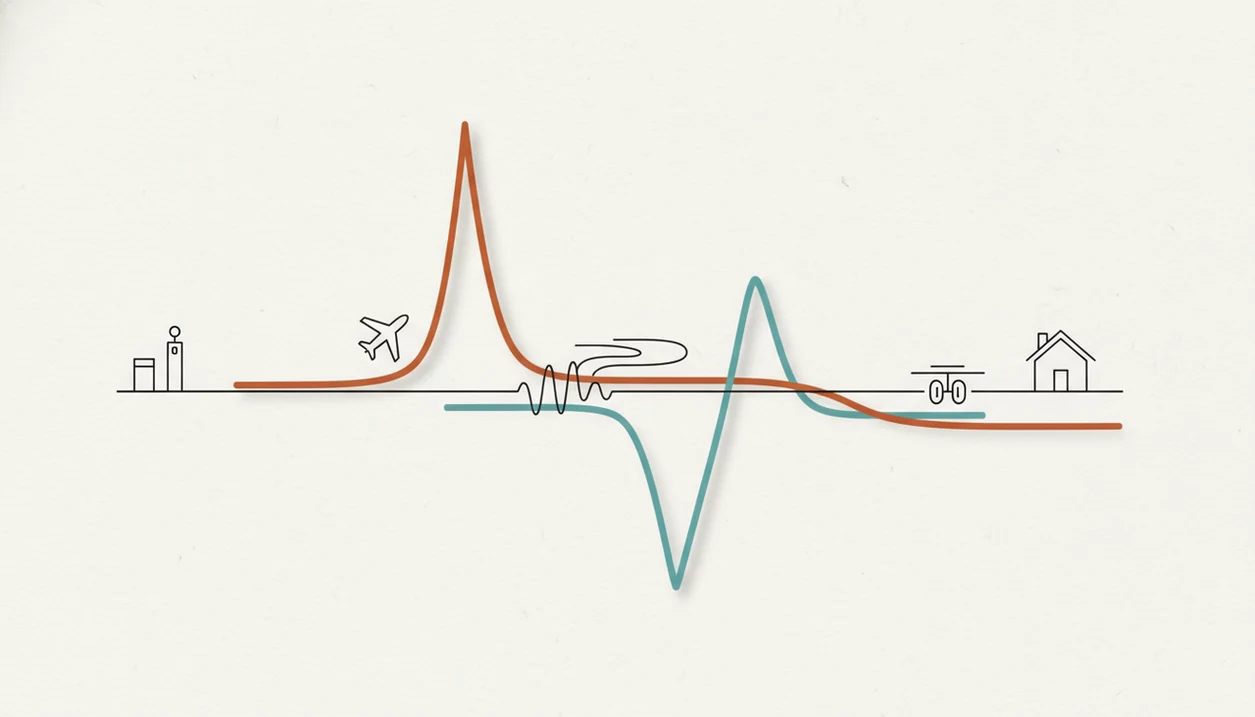
Quick answer: The realistic change is not “I never feel anxious again.” It is usually “my anxiety arrives later, peaks lower, and leaves sooner.”
Before practice, flight anxiety often looks like anticipatory dread, tight shoulders, stomach tension, repeated weather checks, seat-map scanning, and catastrophic thoughts about normal flight events. A 2016 global survey found that 36% of air travelers reported some fear of flying, and 18% reported moderate to high fear, so this pattern is not rare source.
After repeated practice, many nervous flyers still feel a spike at the gate or during takeoff. The difference is that they can name the fear, use a breathing or grounding plan, and recover faster after landing.
Progress can be quiet.
A better flight may simply mean you board without asking your partner three times if the aircraft is safe.
How flight anxiety before-and-after progress works
Flight anxiety before-and-after progress works because the brain updates what flight cues mean. Airports, engine changes, turbulence, banking, and body sensations can become threat signals; practice helps them become cues you can tolerate and recover from.
This is threat learning: the nervous system pairs a sound, feeling, or place with danger, then reacts quickly the next time it appears. Repeated practice creates new safety learning. CBT helps you test catastrophic predictions. Exposure lets you stay with flight reminders long enough for the alarm to fall. Breathing lowers arousal so chest tightness, shaking, or stomach drops feel less like proof of danger. Reframing gives ordinary aviation events more accurate labels, such as “air movement” instead of “something is wrong.”
A simple progress loop looks like this:
- Notice the cue, such as the gate, takeoff thrust, turbulence, or adrenaline.
- Name the feared prediction without treating it as a fact.
- Use a practiced skill, such as slower breathing, grounding, or a reframe.
- Stay with the moment until the spike starts to pass.
- Record recovery time afterward.
The goal is not zero anxiety. It is faster recovery, less avoidance, and more confidence that anxiety can rise and fall without taking over the whole trip.
Fear of flying before-and-after examples across 7 travel-day moments
Fear of flying before-and-after progress is easiest to see when you compare the same travel moments across several trips. One flight can be noisy or bumpy, so track patterns instead of judging yourself by a single journey.
| Travel-day moment | Before practice | After repeated practice |
|---|---|---|
| Night before | Sleeps 2 hours, checks turbulence maps, twists pillows after restless sleep | Sleeps 5 hours, checks the plan once, uses a wind-down track |
| Airport arrival | Feels trapped, scans departure boards, stomach clenches | Rates anxiety 6/10 and starts a saved breathing exercise |
| Boarding | Seeks repeated reassurance from a companion | Boards with one planned reassurance phrase |
| Takeoff | Interprets the stomach drop after takeoff as danger | Labels it as acceleration and keeps breathing steady |
| Turbulence | Watches crew faces and grips the armrest | Uses grounding and reminds themselves bumps are expected |
| Landing | Braces for every turn and sound | Notices tension but follows the descent plan |
| After landing | Replays the flight all evening | Recovers in 30 minutes, then logs what happened |
For first-time flyers, a stage-by-stage plan can sit alongside basic first flight anxiety tips.
Flight anxiety progress in the nervous system
Flight anxiety improves when the brain learns new safety associations with flight cues, not because someone simply decides to “calm down.” In behavioral terms, threat learning links airports, engines, banking, turbulence, and body adrenaline with danger.
The nervous system can misread ordinary sensations. A banking turn may feel like dropping. Engine sound changes may sound like failure. Adrenaline can cause sweating, shaking, chest tightness, and a rush of “I need to get out,” even when the aircraft is operating normally.
How flight anxiety before-and-after change works: CBT, gradual exposure, breathing, grounding, meditation, and cognitive reframing help the brain pair flight cues with coping and safety rather than escape.
Clinicians typically recommend structured psychological approaches such as CBT and exposure for persistent phobias, often combined with relaxation skills. The most common medically supported way to reduce phobic avoidance is repeated exposure combined with cognitive reframing.
5 steps to track nervous flyer improvement before each flight
A nervous flyer improvement plan should measure the same signals before, during, and after several flights. Don’t rely on memory from the worst ten minutes of the trip.
- Score your baseline from 0 to 10 for sleep, dread, boarding, takeoff, turbulence, landing, and recovery.
- Log safety behaviors such as weather checking, seat checking, alcohol use, crew scanning, or reassurance seeking.
- Choose one practice tool for each stage, such as breathing before boarding, grounding at takeoff, and journaling after landing.
- Use the same scale after the flight, including how long it took to feel normal again.
- Review several flights before drawing conclusions, because one rough route can distort the picture.
A downloaded flight-anxiety practice plan can help some flyers organize sessions before, during, and after a trip, especially when the airport Wi-Fi drops and boarding starts sooner than expected. For frequent business routes, compare the routine with a flight anxiety app for frequent travelers.
Morning flight sleep vignette: Maya before and after practice
Maya is an illustrative example, not a promised result. Before practice, her 6:20 a.m. flight starts the evening before. She checks the weather four times, reads storm forecasts she does not understand, and feels her stomach tighten every time the 3 a.m. airport transfer reminder lights up.
Her practice plan is small. At 9:30 p.m., she does an evening meditation. Then she writes one cognitive reframe: “Forecasts are not flight decisions; pilots and dispatchers handle that.” In bed, she plays a short hypnosis-style relaxation track and keeps her phone across the room.
Still nervous, yes.
After several trips, Maya does not become casual about flying. She does sleep closer to five hours than two, packs without spiraling, and reaches the gate with a clearer boarding plan. That kind of fear of flying before after change is meaningful because it gives the next practice session somewhere to start.
Takeoff and turbulence vignette: Daniel before and after coping practice
Daniel’s fear peaks during takeoff and turbulence. Before practice, he grips the armrests, watches flight attendants for facial cues, and treats every bump as evidence that something is wrong. When the cabin bins click shut, his body is already braced.
His practice routine combines paced breathing, grounding, turbulence education, and short cognitive labels. He writes “acceleration,” “banking,” “air movement,” and “adrenaline” in his notes so he has names ready before panic fills the space.
Research on CBT-based fear-of-flying programs has reported reductions in flight anxiety on standardized scales, with some benefits maintained at follow-up. Meta-analytic evidence also supports virtual reality exposure therapy for anxiety disorders, including fear-of-flying studies, with large effects compared with control conditions source.
Daniel’s after-practice flight is not smooth emotionally. Anxiety rises at takeoff. But he labels it, breathes through it, and stops treating every movement as a new emergency.
Post-landing recovery vignette: Priya before and after decompression
Priya used to think the work ended at touchdown. Then the brakes hummed after landing, her legs shook, and she spent the evening replaying the one rough patch over the mountains.
Before practice, she felt wired, exhausted, and embarrassed after every flight. Her body was safe, but her brain kept reviewing the evidence as if the case were still open.
Her decompression routine is brief. She does two minutes of slower breathing at the gate, then writes three facts: what she feared, what happened, and what helped. Later, she adds one safety memory: “Turbulence happened, and the aircraft continued normally.”
The after phase matters because the brain stores the story you repeat. For nervous flyer improvement, post-flight reflection can turn “I barely survived” into “I felt panic, used skills, and landed.” If a companion is involved, the guide on how to help someone with flight anxiety can make that support less frantic.
5 common nervous flyer improvement patterns after repeated practice
Progress often shows up as doing the same flight with less avoidance, not feeling calm from start to finish. Different people also respond to different techniques, so the pattern matters more than one favorite exercise.
- Less anticipatory dread: The flight no longer takes over the whole week, even if the night before still feels tense.
- Fewer reassurance loops: You may check the weather once instead of refreshing turbulence forecasts for an hour.
- Improved tolerance of sensations: Engine changes, banking, and bumps still register, but they do not automatically become danger.
- Better recovery: You come down from the stress response faster after landing, sometimes within 30 minutes instead of all evening.
- More willingness to fly again: You may still dislike flying, but you can book the next trip without weeks of avoidance.
For many nervous flyers, breathing works best when anxiety is rising, while cognitive reframing fits moments when catastrophic thoughts are running the show.
Flight anxiety before-and-after stories and clinical proof
Before-and-after stories are useful for recognition, but they are not clinical proof. A log can show that you slept longer, checked less, or recovered faster, yet it cannot diagnose the cause of severe panic or trauma-linked fear.
Some people need stronger support. Severe panic symptoms, avoidance that affects work or family, trauma history, or broader anxiety disorders are good reasons to speak with a licensed therapist. Medication can also help some people short term, but sedating medicines such as benzodiazepines can cause impairment and carry dependence concerns with repeated use. The FDA warns that benzodiazepines carry risks of abuse, addiction, physical dependence, and withdrawal with use over time source.
App-based meditation, hypnosis, and cognitive tools are supports, not substitutes for individualized care. App-based meditation, hypnosis-style relaxation, and cognitive tools can provide repeatable coping practice, but they are not a guaranteed cure or a medical assessment.
If you are comparing tools, a best flight anxiety app guide should compare features, not promises.
Limitations
Flight anxiety progress is real for many people, but the limits matter.
- Meditation, hypnosis, breathing, and cognitive techniques usually require repeated practice across several flights.
- Some nervous flyers may not see meaningful change without CBT, exposure therapy, or other professional support.
- Severe panic symptoms, trauma-linked flying fear, or complex mental health needs should be assessed by a licensed professional.
- Short-term flight anxiety medication may reduce distress, but it can cause sedation and carries dependence risk with repeated use.
- Medication may blunt learning for some people if it prevents them from practicing coping skills while experiencing flight cues.
- Current research on app-delivered hypnosis and meditation specifically for fear of flying is more limited than research on CBT and exposure.
- Progress can fluctuate because sleep, stress, route, turbulence, travel companions, and life events affect anxiety on any given flight.
A rough flight is data, not failure. Review the whole pattern before changing the plan.
FAQ
Can flight anxiety improve?
Yes. Many nervous flyers improve with repeated practice, CBT-style tools, exposure, relaxation methods, and better understanding of normal flight sensations.
How long does flight anxiety progress take?
Improvement often takes multiple practice sessions or several flights rather than one attempt. Track sleep, dread, takeoff anxiety, turbulence reactions, and recovery time over time.
Why am I anxious after flying?
Post-flight anxiety can come from leftover adrenaline, rumination, nervous system activation, and mental replaying of the flight. A short decompression routine can help consolidate safer memories.
Is turbulence anxiety normal?
Yes. Turbulence anxiety is common because anxious brains often misread bumps as danger, even when turbulence is an expected part of flying.
Does meditation help flight anxiety?
Meditation can help reduce arousal and improve attention control when practiced consistently. It is usually more useful as a repeated skill than as a one-time emergency fix.
Does hypnosis help fear of flying?
Hypnosis-style relaxation may support down-regulation and calmer imagery for some nervous flyers. Evidence specific to app-delivered hypnosis for fear of flying is more limited than evidence for CBT and exposure.
Should I take medication for flight anxiety?
Medication for flight anxiety is a medical decision and should be discussed with a clinician. Sedation, impairment, interactions, and dependence risk are important considerations.
When should I seek therapy for fear of flying?
Seek therapy if flight anxiety causes severe panic, major avoidance, trauma-related distress, or persistent impairment. A licensed clinician can assess whether CBT, exposure therapy, medication support, or combined care is appropriate.