Can An App Cure Fear Of Flying Or Only Support Coping?
For the question can an app cure fear of flying, the realistic answer is no: an app can support coping, practice, and confidence, but it should not promise to cure a phobia. For many nervous flyers, app-based meditation, breathing, hypnosis-style relaxation, flight education, and cognitive techniques can make flights more manageable; severe aerophobia often needs structured CBT, exposure therapy, or professional care.
> Scope: This article discusses app-based support for fear of flying, not diagnosis, medical treatment, medication advice, or emergency care.
TL;DR
- A fear of flying app can help you manage anticipatory anxiety, in-flight panic sensations, and catastrophic thoughts, but it cannot guarantee a permanent cure.
- Digital anxiety tools work best when they are structured, practiced repeatedly, and combined with gradual exposure rather than used only during a crisis.
- If flying fear causes avoidance, panic attacks, major life disruption, or safety behaviors you cannot control, therapy is usually the more appropriate next step.
Fear of flying app cure expectations at a glance
A fear of flying app can support coping, but it should not claim to cure aerophobia. The useful distinction is simple: nervous flying is uncomfortable; a clinically significant phobia can reshape travel, work, family plans, and daily anticipation.
An app may help if you still fly but dread the calendar square circled in red. It can give you breathing practice, body calming, flight education, and thought reframes before the airport day arrives. Self-help tools can be part of that support, but they are not medical treatment or a diagnosis.
The pocket check is real.
Repeat practice matters more than opening an app only when boarding starts. A five-minute exercise used daily for two weeks usually has more value than a first-time track started during takeoff.
Flight anxiety app treatment versus phobia care
Can a flight anxiety app treat phobia? A flight anxiety app may reduce symptoms, but it is not the same as clinician-led treatment for a specific phobia.
App tools can lower physical arousal by slowing breathing, relaxing muscle tension, and giving the mind a task. Cognitive prompts can also challenge predictions like “turbulence means danger” or “panic means I’m unsafe.” That can be genuinely useful when your jaw clenches at cruising altitude.
Phobia care is different. It often uses graded exposure and response prevention, which means gradually learning that feared cues can be tolerated without escape rituals or repeated reassurance. Clinicians typically recommend CBT with exposure-based methods for specific phobias when fear causes avoidance or major impairment.
Specific phobias affect about 12.5% of U.S. adults at some point in life and 9.1% in a given year, according to NIMH data source. So this is common, but not trivial.
Five facts about aerophobia app limits and evidence
- There is no one-click app cure for everyone. Fear learning, avoidance, panic history, and past flying experiences vary too much for a universal fix.
- Apps can deliver useful coping tools. Meditation, breathing, hypnosis-style relaxation, flight education, and cognitive techniques can all fit on a phone.
- Structured digital treatment can reduce anxiety. Research on internet-based CBT suggests digital programs can help when they follow evidence-based methods, not just calming audio.
- Virtual exposure has evidence for flying fear. A randomized trial of virtual reality exposure therapy for fear of flying reported reduced flight anxiety and greater likelihood of flying after treatment source.
- Severe aerophobia often needs more than self-help. Panic attacks, avoidance, trauma history, or major disruption are signs to consider therapy.
The most common medically supported way to reduce phobic fear is structured exposure combined with cognitive skills and repeated practice. Apps are best framed as supportive companions, not permanent cure machines.
Fear of flying apps in the anxiety loop
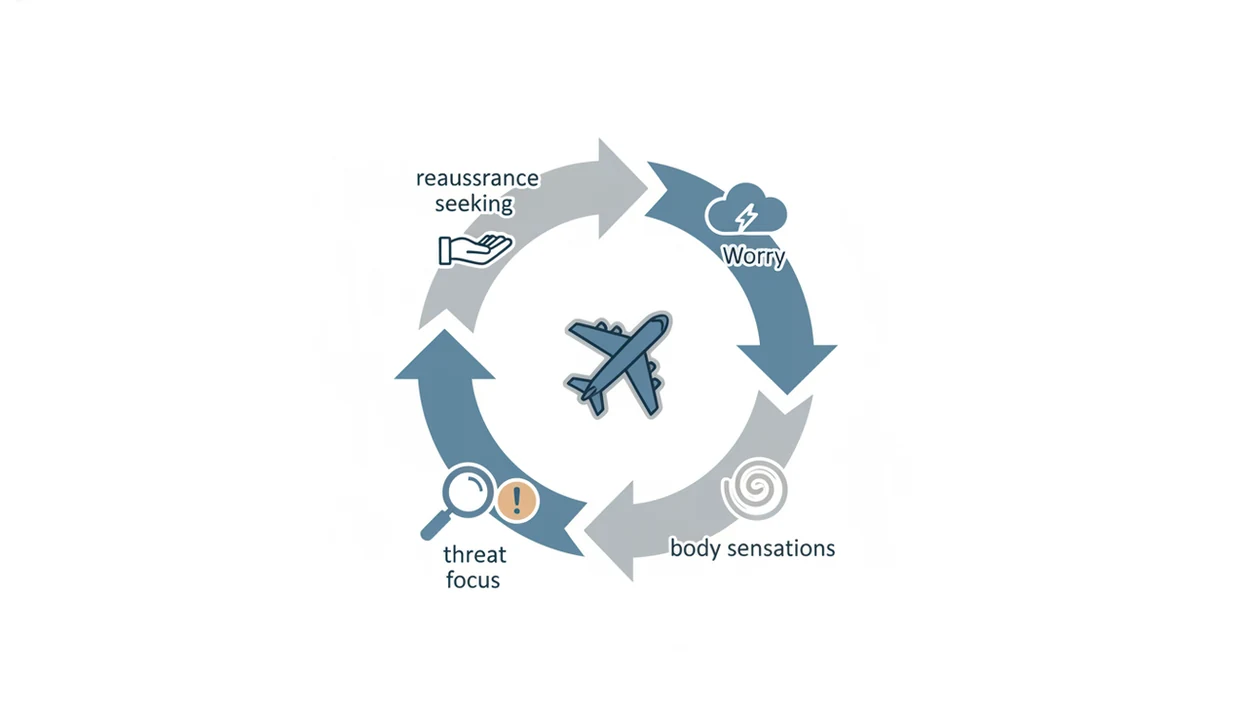
Fear of flying apps work on parts of the anxiety loop: trigger, body alarm, catastrophic interpretation, avoidance, and temporary relief. In plain English, the brain treats a cue as danger, the body surges, the mind explains the surge as proof, and avoidance teaches the loop to return.
How fear of flying app support works: breathing and meditation can reduce autonomic arousal, meaning the body’s alarm system may settle. Cognitive techniques target threat appraisal, which is the story your brain tells about the sensation. Flight education can reduce uncertainty about normal aircraft sounds, such as engines deepening before takeoff.
For a nervous flyer, that can be enough to stay present during boarding, takeoff, turbulence, and landing. But soothing alone may not change phobic learning if every flight is still treated as something to survive.
For many nervous flyers, coping tools work best when they are practiced before fear peaks, while therapy fits people whose avoidance keeps confirming danger.
Fear of flying app support versus exposure therapy
App support and exposure therapy are related, but they are not the same. Exposure means gradually learning that feared cues can be tolerated; it does not mean forcing panic or “white-knuckling” a flight without support.
| Approach | What it helps | Best fit | Limitation |
|---|---|---|---|
| App-only support | Breathing, relaxation, reframing, flight education | Mild to moderate nervous flyers who still travel | May not change long-standing avoidance |
| Structured digital CBT | Thought patterns, safety behaviors, repeated practice | People who can follow a planned program | Quality varies by program |
| Virtual reality exposure therapy | Simulated takeoff, turbulence, cabin cues | People avoiding flights or needing graded practice | Often works best with clinical structure |
| Clinician-led CBT/exposure | Phobic learning, avoidance, panic responses | Severe, complex, or disabling aerophobia | Requires time, cost, and access |
The practical question is not “app or therapy?” It is what level of structure your fear needs. If symptoms are intense, our guide on when to see therapist for fear of flying explains the decision points in more detail.
Four myths about a fear of flying app cure
Myth 1: An app can cure long-standing flying phobia in a few sessions. A few calm sessions may help, but a phobia usually needs repeated learning across feared cues.
Myth 2: If one flight goes badly, digital tools cannot help. A rough flight can overwhelm new skills. That does not mean the skills are useless; it may mean they were under-practiced.
Myth 3: Meditation or hypnosis removes the need for flight education. Relaxation can settle the body, but accurate information helps the mind interpret turbulence, cabin noises, and routine movement.
Myth 4: Panic attacks on planes can always be self-treated. Some people can ride out symptoms with breathing and grounding. Recurrent panic, fainting fears, or medical worries deserve professional advice.
Meditation, hypnosis-style relaxation, and cognitive techniques can offer structured coping practice, not a guaranteed cure for aerophobia.
Mild aerophobia app support before a flight
App-based self-help may be a reasonable first step when fear is mild to moderate and you are still flying. That might look like anticipatory worry, shoulder tension, turbulence dread, trouble sleeping before an early flight, or difficulty relaxing once seated.
How to use fear of flying app support before travel:
- Start practice before flight week. Use a short breathing or meditation session daily, not only at the gate.
- Choose one takeoff tool. Save a specific audio for taxi and takeoff so you are not scrolling under stress.
- Download sessions offline. Airport Wi-Fi drops at exactly the wrong time.
- Pair education with calming. Read or listen to flight explanations before turbulence becomes the focus.
- Review after landing. Note what helped, what did not, and what to practice next time.
Programs such as SOAR, British Airways Flying with Confidence, airline fear-of-flying courses, and structured CBT tools can support this kind of practice. If you are preparing for a first trip, a flight anxiety app for first-time flyers may be a better starting point.
Flight anxiety app red flags for therapy
App-only coping is less appropriate when fear blocks necessary travel, causes panic attacks, or leads to rituals you cannot control. Red flags include avoiding important trips, repeated reassurance searches, fear of fainting, crying before flights, or feeling unable to board.
A broader picture matters too. Trauma history, depression, substance use, medication questions, or other anxiety disorders can change what support is safest. If you are considering medication, read about sedatives for fear of flying and discuss options with a clinician rather than mixing advice from forums.
Specific phobias often begin in childhood, with NIMH materials noting a median onset around age 7. That long learning history is one reason last-minute coping tools may not be enough.
CBT, exposure therapy, virtual reality exposure, or medical evaluation may be needed when flying fear is severe, disabling, or medically complicated.
Limitations
Apps can be useful, but the aerophobia app limits are important.
- There is limited direct clinical trial evidence showing that fear-of-flying apps work as stand-alone cures.
- Self-guided tools depend on motivation, repetition, timing, and correct use.
- Relaxation or hypnosis-style audio may soothe symptoms without changing phobic learning.
- Severe phobias, trauma histories, major depression, substance use, or panic disorder may require professional care.
- Apps cannot prescribe medication, diagnose mental health conditions, or manage medical emergencies.
- Apps cannot guarantee a calm flight, a turbulence-free trip, or permanent removal of fear.
- Some users may overuse reassurance content, which can become another safety behavior.
If you only have five minutes, use the app for one breathing exercise and one clear thought reframe. But if fear keeps shrinking your life, the practical next step is professional support, not a longer playlist. Privacy questions also matter, especially with sensitive anxiety notes; our guide to privacy in flight anxiety apps covers what to check.
FAQ
Can an app cure aerophobia?
An app may help manage aerophobia symptoms, but it should not be framed as a guaranteed cure for a specific phobia. Severe or long-standing fear often needs structured CBT, exposure therapy, or clinician support.
Do flying anxiety apps work?
Flying anxiety apps can help many nervous flyers when used consistently for breathing, relaxation, education, and cognitive coping. They are less reliable when used only during a crisis.
Is a fear of flying app a medical treatment?
No. A fear of flying app is supportive self-help, not a medical treatment or replacement for diagnosis, therapy, or medical care. It can support coping practice before and during flights.
Can apps stop panic attacks on a plane?
App tools may reduce panic intensity for some people by guiding breathing, grounding, and thought reframing. Recurrent panic attacks on planes should be discussed with a mental health professional or physician.
What helps severe flying phobia?
Severe flying phobia is commonly treated with CBT, graded exposure, virtual reality exposure, and clinician support. App tools may be used alongside treatment, but should not be the only plan for disabling fear.
Is exposure therapy necessary for fear of flying?
Exposure is often central for phobias because it helps the brain relearn feared cues through repeated, tolerable practice. Treatment plans vary, so a clinician can help decide the safest format.
Can hypnosis help flying fear?
Hypnosis-style relaxation may support calm and reduce tension before or during a flight. By itself, it is unlikely to resolve phobic learning if avoidance and catastrophic predictions remain unchanged.
When should I see a therapist for flight anxiety?
See a therapist if flight anxiety causes avoidance, panic attacks, major distress, trauma reactions, compulsive reassurance, or broader mental health concerns. Professional help is also appropriate if you feel unable to board or travel safely.