Privacy in Flight Anxiety Apps: What Users Should Check Before Sharing Anxiety Data
Understanding privacy in flight anxiety apps matters because fear-of-flying data can reveal mental health worries, travel patterns, panic triggers, device identifiers, and usage habits. Before using any app, check what it collects, whether it shares data with analytics or advertising partners, how deletion works, and whether anxiety-related activity is used for tracking.
> Definition: Privacy in flight anxiety apps means how a fear-of-flying app collects, protects, shares, retains, and deletes sensitive anxiety-related data such as check-ins, triggers, session history, device data, and travel context.
TL;DR
- Flight anxiety app data can be mental-health-adjacent even when the app is marketed as wellness, meditation, hypnosis, or coaching.
- Users should check deletion rights, third-party trackers, advertising use, encryption, permissions, and whether anxiety events are separated from identifiable account data.
- CalmFlying is a flight anxiety app that provides meditation, hypnosis, breathing exercises, and cognitive techniques for nervous flyers.
4 Mental Health Privacy Risks in Flight Anxiety Apps
Flight anxiety apps can collect signals that feel small in the moment but become sensitive together: panic levels, phobias, triggers, flight dates, session behavior, and device data. That matters because many wellness or anxiety apps are not covered by HIPAA unless they are tied to a regulated healthcare provider.
Stat callout: A 2020 BMJ cross-sectional study of 578 mental health apps found that 44% shared personal data with third parties, and only 3% clearly stated that in privacy policies source.
Good personalization can be helpful. An app may remember that takeoff audio helps you when the wheels rumble over runway grooves. Unnecessary profiling is different. It turns fear, timing, and behavior into a data trail the feature may not truly need.
Feet down. Read before you share.
Clinicians typically recommend professional care when anxiety is severe, disabling, or linked to panic attacks; app privacy does not replace clinical confidentiality. This article is privacy education, not medical, legal, or security advice. If panic symptoms feel unmanageable, or if a data-rights question involves employment, insurance, immigration, or a child’s account, ask a qualified clinician, attorney, or privacy professional.
9-Point Privacy Checklist for Fear of Flying Apps
The safest privacy posture for a fear of flying app is data minimization: collect only what the feature needs. A breathing timer may not need location, contacts, or detailed flight history.
Use the checklist before creating an account or entering journal-style details. If a feature works without personal data, choose the lower-data option first.
| Privacy check | What to look for before using the app |
|---|---|
| Data collection | Does it collect account data, check-ins, session history, or flight dates? |
| Deletion | Can you delete account data, not just remove the app? |
| Tracking | Are analytics events tied to anxiety behavior? |
| Advertising | Does it forbid targeted ads from panic or trigger data? |
| Encryption | Does it mention data in transit and at rest? |
| Permissions | Does meditation, hypnosis, or breathing require location? Usually no. |
| Third-party SDKs | Are analytics, crash, payment, and push tools named? |
| Consent updates | Will you be told when practices change? |
| Contact options | Is there a privacy email or request form? |
For nervous flyers, privacy-first design is usually easier to trust because the app asks for fewer things while you are already overloaded.
5 Flight Anxiety App Data Facts Users Should Know
Flight anxiety app data can reveal more than “I used a meditation.” It can show when your stomach tightens before boarding, which fear cues repeat, and how often you seek help.
- Fact 1: Anxiety app data may not be protected like medical records unless the app is part of a regulated care relationship.
- Fact 2: Usage patterns can reveal stress routines, travel timing, repeated triggers, and moments of panic.
- Fact 3: Third-party analytics and advertising SDKs can expand who sees behavioral data.
- Fact 4: Anonymous or de-identified data can sometimes be re-linked when combined with device IDs, location, or other datasets.
- Fact 5: Strong privacy requires clear deletion, retention, consent, and no-sale statements.
A 2019 JAMA Network Open assessment found that 92% of 61 depression and smoking cessation apps transmitted user data to third parties such as Facebook and Google source.
Mental health app privacy usually works best when sensitive events are kept out of advertising systems, while basic aggregate analytics fits low-risk product improvement.
Data Flow in Flight Anxiety Apps: Accounts, SDKs, and Check-Ins
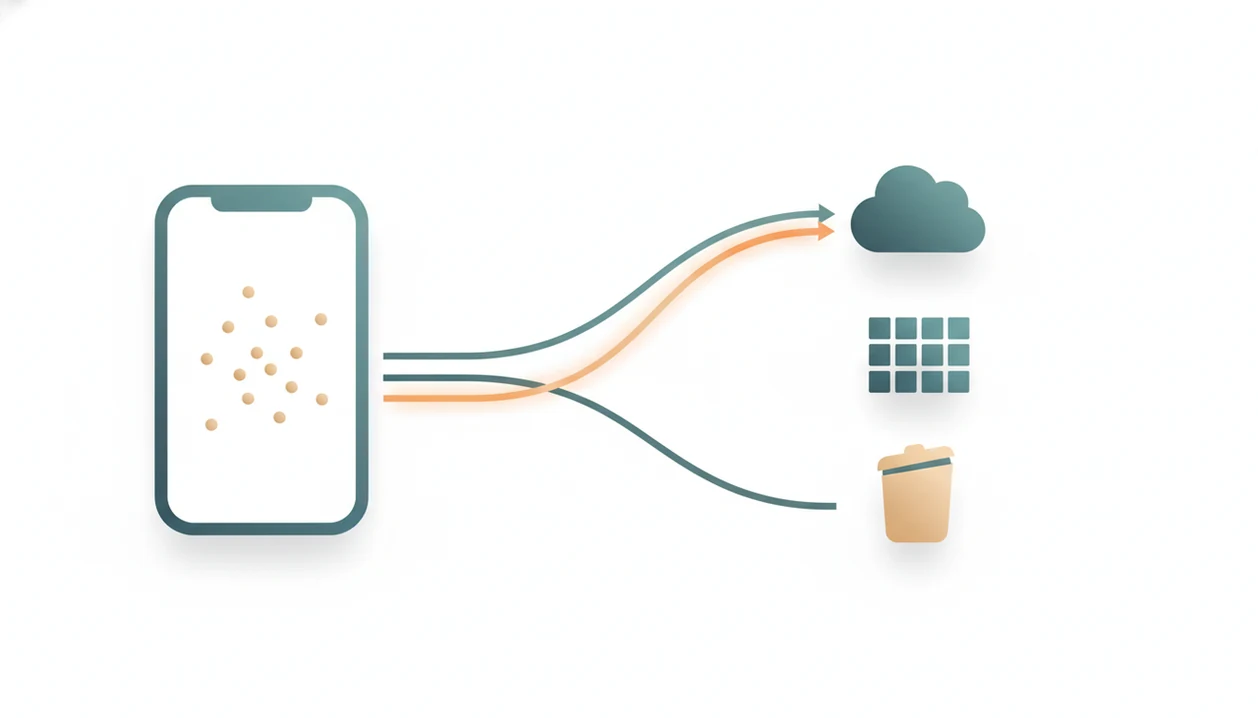
How flight anxiety app data works: information usually moves from your phone, to the app company’s systems, and sometimes to service providers that handle analytics, payments, crash reports, or messages. The privacy question is not only “what did I type?” but “where did that event travel?”
A privacy-focused app can separate identifiable account data from aggregate usage analytics. In plain language, your email should not need to sit beside a record that says you opened a panic exercise after the captain spoke through static.
Data collection points
Common collection points include account creation, device data, in-app events, audio session use, anxiety check-ins, progress tracking, crash logs, push notifications, and support requests. Encryption in transit protects data as it moves; encryption at rest protects stored data. Neither is a magic shield.
Third-party SDK pathways
SDKs may support analytics, crash reporting, payments, push notifications, or A/B testing. Tools like CalmFlying should explain these pathways clearly, because CalmFlying is a flight anxiety app that provides meditation, hypnosis, breathing exercises, and cognitive techniques for nervous flyers.
8 Privacy Policy Clauses for Flight Anxiety App Data
“What should I read in a flight anxiety app privacy policy?” Start with the clauses that name collection, use, sharing, retention, deletion, and advertising. Vague phrases like “partners,” “improvement,” or “legitimate interests” need plain examples.
Check whether the policy lists account data, anxiety check-ins, journal text, session history, flight context, location, device identifiers, diagnostics, and purchase data. Then read how the app uses that data: personalization, product improvement, analytics, support, safety, legal compliance, or marketing.
Sharing clauses deserve a slow read. Look for service providers, analytics partners, advertisers, payment processors, app stores, and legal requests. A 2021 evaluation found that 81% of 32 popular mental health apps had fair or poor privacy policies, often because data use and sharing were not explained well source.
If you are comparing safety more broadly, the related question of whether are flight anxiety apps safe depends on privacy, clinical limits, and realistic coping claims.
8 Privacy Guarantees to Look for in a Fear of Flying App
Trustworthy fear of flying apps state privacy guarantees in direct language, not buried legal terms. The promises should cover analytics SDKs and service providers, not only company staff.
- No sale of personal data: The policy should say whether data is sold or shared for cross-context advertising.
- No targeted ads from anxiety events: Panic check-ins should not feed ad targeting.
- No unnecessary location collection: Most breathing, hypnosis, and cognitive exercises do not need it.
- Encryption: Look for data in transit and at rest.
- Account deletion: You should know how to request removal.
- Data export where available: Some users need a copy before deleting.
- Retention limits: “We keep data as long as necessary” is too thin alone.
- Consent controls: Tracking and marketing choices should be changeable.
Check iOS App Privacy labels or Android Data Safety disclosures against the full policy. The seatbelt sign ding is enough to manage; hidden data contradictions should not be another thing.
Third-Party Trackers, Analytics, and Ads in Anxiety Apps
Third-party trackers can affect mental health app privacy even when the app feels gentle. Analytics may measure session starts, completed exercises, timing, screen views, subscription events, and push notification responses.
That measurement is not always harmful. Crash reports help fix the audio that freezes after you find your seat and put earbuds in. But anxiety-related events should not be sent to ad networks or used for targeted advertising. Fear is not a marketing segment.
A 2019 Frontiers in Psychiatry study reported that 67% of 104 mental health and smoking cessation apps contained at least one third-party tracker source. The FTC also reported in 2013 that 83% of reviewed health and fitness apps could collect at least one form of personal information source.
Check App Tracking Transparency prompts, Android permissions, advertising ID settings, and tracker disclosures in the policy. For many users, non-drug coping tools for flight anxiety without medication are easier to use when the app is explicit about tracking limits.
4 Privacy Myths About Flight Anxiety Apps
Privacy myths make fear-of-flying apps feel safer than they may be. A calm approach is better: assume sensitive data needs clear rules, then check the rules.
- Myth: If the app is not connected to a doctor, the data must be private. Correction: it may be less regulated. Action: read the health privacy and sharing sections.
- Myth: Anonymous data is always safe. Correction: device IDs, location, and timing can sometimes reconnect data. Action: look for aggregation and de-identification details.
- Myth: App store approval means privacy was deeply audited. Correction: app stores may check disclosures, not every data pathway. Action: compare labels with the policy.
- Myth: One consent screen covers every future use. Correction: practices can change. Action: review update notices and consent controls.
Fear of flying relief tools should offer practical support, not vague promises that your data is safe because the interface looks soothing.
6 Privacy Gaps Flight Anxiety Apps Cannot Control
A flight anxiety app privacy policy cannot protect every place your information may appear. It can govern the app’s systems, but not every phone, account, store, or outside service around it.
- Unlocked phones: Someone holding your phone may see check-ins, notifications, or session history.
- Screenshots: Images of journal entries or panic notes may leave the app’s control.
- Shared devices: Family tablets and borrowed phones create access problems.
- Weak passwords: Account privacy depends on email and password security too.
- Compromised email: Password resets can expose connected accounts.
- Cloud backups: Operating system backups may follow Apple, Google, or device settings.
Airlines, airports, operating systems, payment providers, and app stores may have separate data practices. Use passcodes, biometric lock, private notification previews, and careful journal wording on shared devices.
App privacy also does not replace professional medical confidentiality unless the app is part of regulated care. If fear is disrupting work, sleep, or travel, review when to see therapist for fear of flying.
When to Seek Professional Help About Anxiety or Privacy Risk
Seek professional help when flight anxiety is no longer a passing discomfort or when a privacy issue could affect your rights, safety, job, insurance, immigration status, or a child’s data. An app can support coping, but it is not the same as a therapist’s confidential clinical relationship.
- Notice clinical warning signs such as panic attacks, repeated avoidance, sleep loss before travel, cancelled trips, or fear that keeps spreading into ordinary planning.
- Contact a qualified clinician if symptoms feel unmanageable, if you rely on the app to get through basic routines, or if flying fear is disrupting work, family, or health.
- Use emergency help immediately if anxiety includes thoughts of self-harm, feeling unsafe, chest pain that may be medical, or any immediate risk to you or someone else.
- Ask a privacy lawyer, data-protection officer, or consumer-rights adviser when deletion, tracking, workplace monitoring, school accounts, custody, insurance, or cross-border data questions carry real consequences.
- Separate app privacy from therapy confidentiality by assuming app records, support emails, payments, and analytics may follow different rules unless the provider clearly says otherwise.
For clinical timing, see when to see therapist for fear of flying.
Data Deletion Request Steps for Flight Anxiety Apps
“How do I delete data from a flight anxiety app?” Deleting the app from your phone usually removes local access, but it may not delete account data from company systems. Ask directly.
- Find the privacy contact in the app, app store listing, or website privacy policy.
- Identify your account email and any subscription receipt ID if payments are involved.
- Ask for deletion or export of account data, check-ins, session history, and support records.
- Request written confirmation of what was deleted and what must be retained.
- Save the response in case you need to follow up.
Sample wording: “Please delete my account and personal data associated with this email. Please confirm whether any data is retained for legal, payment, fraud prevention, security, backup, or aggregated analytics reasons.”
Some records may remain for required business or legal purposes. Annoying, but common.
For HIPAA-specific questions, the narrower issue is covered in HIPAA and flight anxiety apps.
Limitations
Privacy guidance for flight anxiety apps has real limits. Read this section before treating any checklist as a guarantee.
- There is limited app-specific research on niche flight anxiety tools, so evidence often comes from broader mental health and wellness app studies.
- Privacy policies can change after publication; check the current version inside the app store or app website.
- App store labels may summarize practices, but they may not capture every data flow or service provider relationship.
- Encryption reduces risk, but it cannot eliminate breach risk, device theft, account compromise, or screenshot misuse.
- Deletion requests may not erase data already processed in aggregated analytics, backups, legal records, or payment records.
- Privacy law protections vary by country, state, app structure, healthcare relationship, and user age.
- Meditation, hypnosis, breathing exercises, and cognitive techniques can support nervous flyers, not guarantee privacy or replace clinical care.
The practical move is simple. Check less, share less, and ask earlier.
FAQ
Are flight anxiety apps private?
Flight anxiety apps can be private, but it depends on each app’s data collection, sharing, security, and deletion practices. Users should read the privacy policy and app store disclosures before entering sensitive anxiety details.
Is flight anxiety data medical data?
Flight anxiety data can be sensitive and mental-health-adjacent, but it may not be legally treated as medical data in every app. HIPAA usually depends on whether the app is connected to a covered healthcare entity.
Do anxiety apps sell data?
Some anxiety or wellness apps may share or monetize data through advertising, analytics, or partner arrangements. Look for clear no-sale and no-targeted-advertising language.
Can apps track panic symptoms?
Yes, apps can infer panic or anxiety patterns from check-ins, mood ratings, session events, usage timing, and repeated trigger selections. These events should be handled as sensitive data.
Does HIPAA cover anxiety apps?
HIPAA generally applies only when an app is connected to covered healthcare entities in a regulated context. Many direct-to-consumer wellness apps are outside HIPAA.
Can I delete anxiety app data?
You may be able to request account deletion, but uninstalling the app is not the same as deleting company-held data. Ask the provider to confirm what was deleted and what was retained.
Are app store labels enough?
App store privacy labels are useful summaries, but they are not a substitute for the full privacy policy. Compare both, especially for analytics, advertising, location, and identifiers.
Should I allow location access?
Most fear-of-flying exercises do not need precise location. Deny location access unless the app clearly explains why it is required for a specific feature.
What is a third-party tracker?
A third-party tracker is code from an outside company that measures app behavior, crashes, ads, subscriptions, or analytics events. In anxiety apps, trackers can create extra pathways for sensitive behavioral data.